Updating the Near-Earth Object stats for this post, I noticed that the number of known NEO’s has crossed the 20,000 threshold! I need to update this chart every time I talk about asteroids – note the steep angle of the discovery curve, and how the curve keeps growing… precipitously!
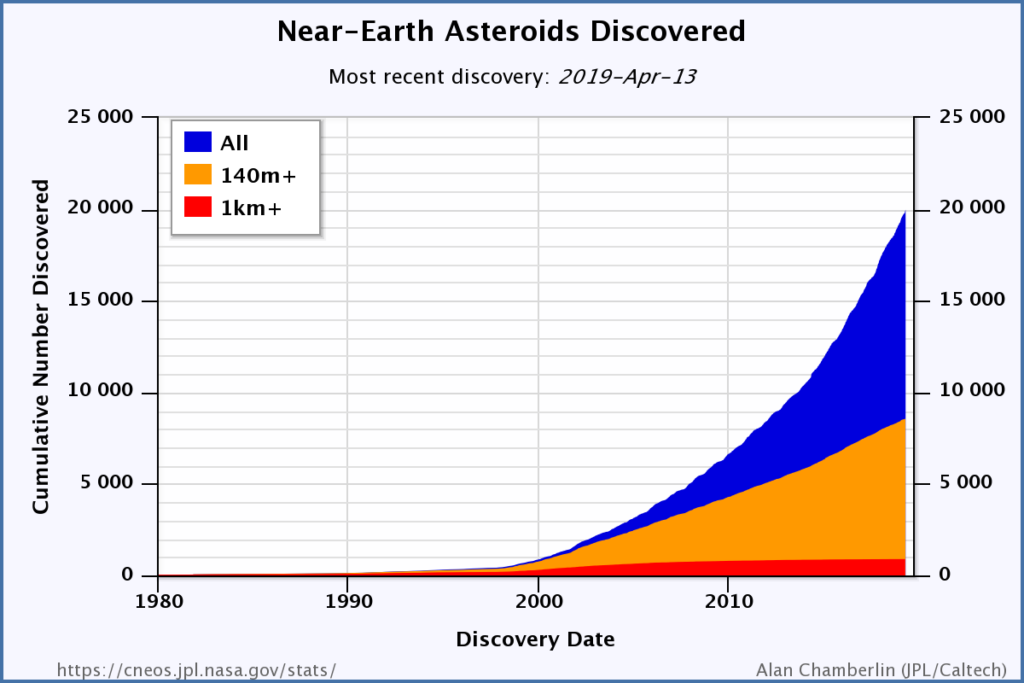 The following chart shows the cumulative number of known Near-Earth Asteroids (NEAs) versus time. Totals are shown for NEAs of all sizes, those NEAs larger than ~140m in size, and those larger than ~1km in size. Credit: NASA/JPL-Caltech/Alan Chamberlin
If you get up at the crack of dawn, and look really low towards the eastern horizon, you may catch a glimpse of Mercury near Venus. Both planets will appear a bit lower in the sky each morning this week.
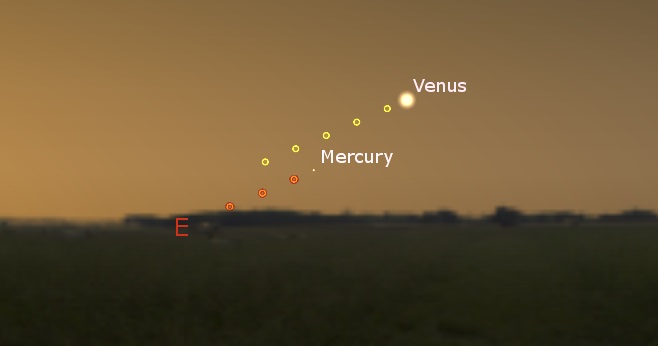 Mercury and Venus LOW in the eastern sky just before sunrise at 6:10 AM on Apr. 17th. The red and yellow dots show the positions of Mercury and Venus over the week. Credit: Stellarium / Bob Trembley.
Saturn, Jupiter and the star Antares appear in southern predawn sky all week; it’s interesting to note that for the last several weeks these all appeared in the south-southeastern predawn sky.
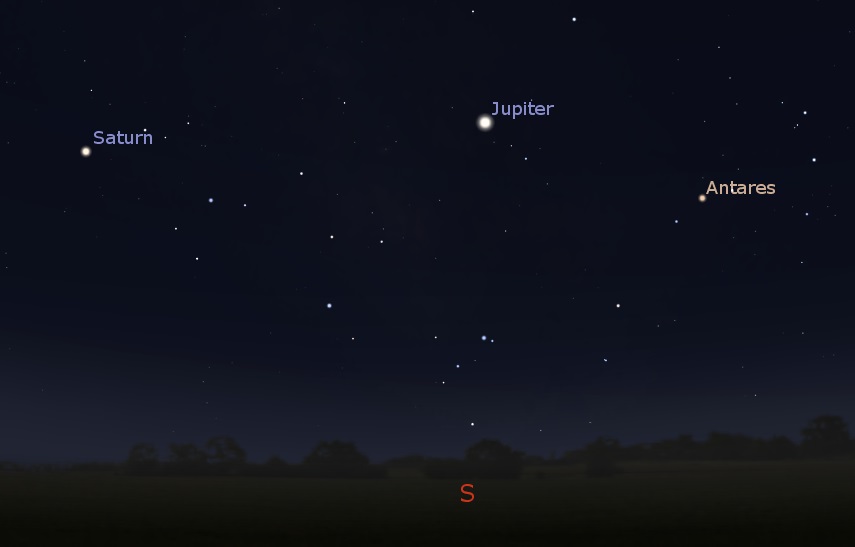 Saturn and Jupiter and the star Antares in the southern predawn sky on Apr. 17, 2019. Credit: Stellarium / Bob Trembley.
Mars and the constellations Orion and Taurus appear in the western sky after sunset. Mars has dimmed significantly since last year; it and the two constellations appear a bit lower in the western sky each evening.
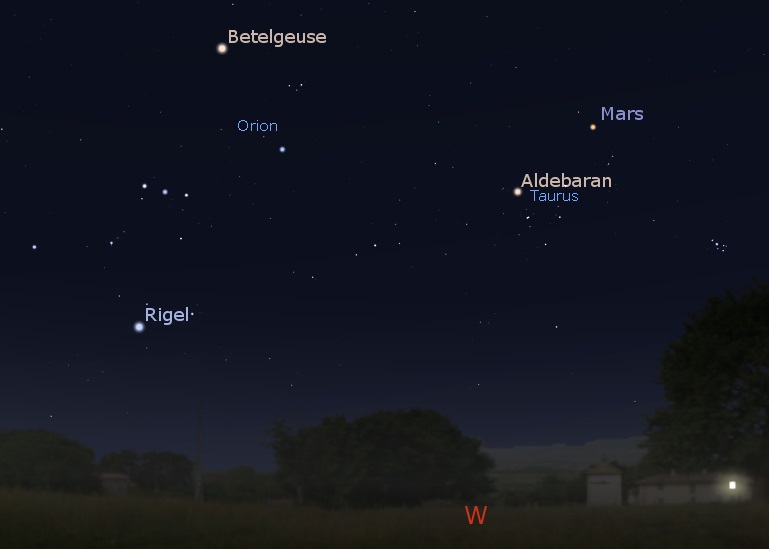 Mars and the constellations Orion and Taurus in the western sky after sunset on Apr. 16, 2019. Credit: Stellarium / Bob Trembley.
Mars continues a slow crawl away from the Pleiades in the western sky after sunset. Mars appears very near the star Tau Tauri (τ Tau) on April, 18th.
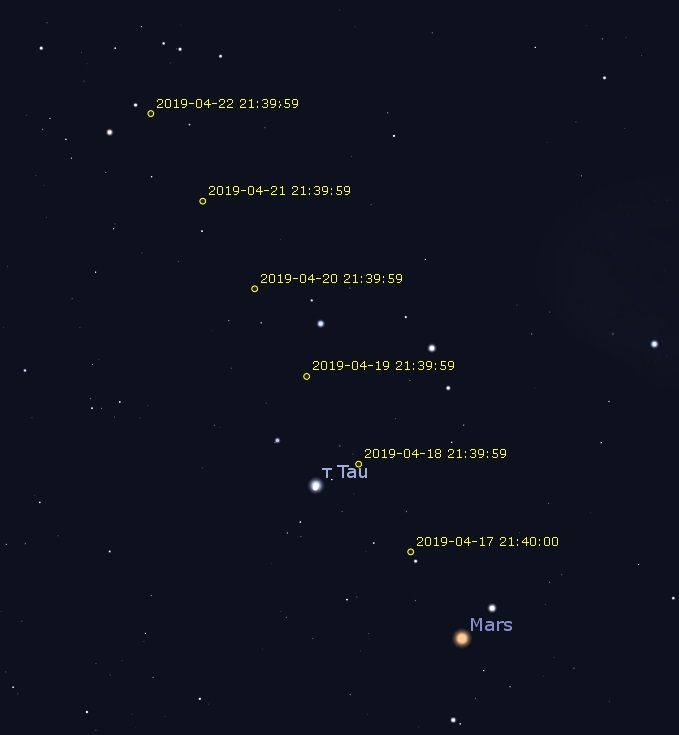 Mars continues a slow crawl away from the Pleiades in the western sky after sunset from Apr. 16-22, 2019. Credit: Stellarium / Bob Trembley.
The full Moon appears near the star Spica in the southeastern sky after sunset on April 18th.
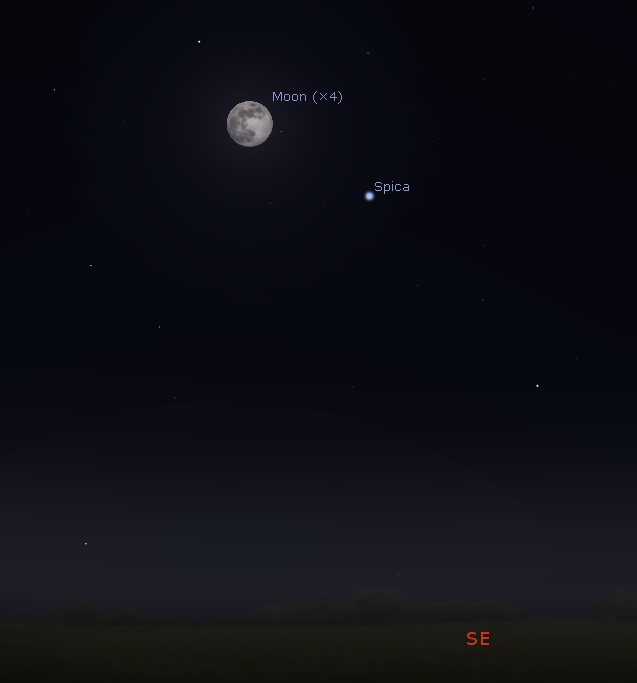 The full Moon near the star Spica in the southeastern sky after sunset on Apr. 18, 2019. Credit: Stellarium / Bob Trembley.
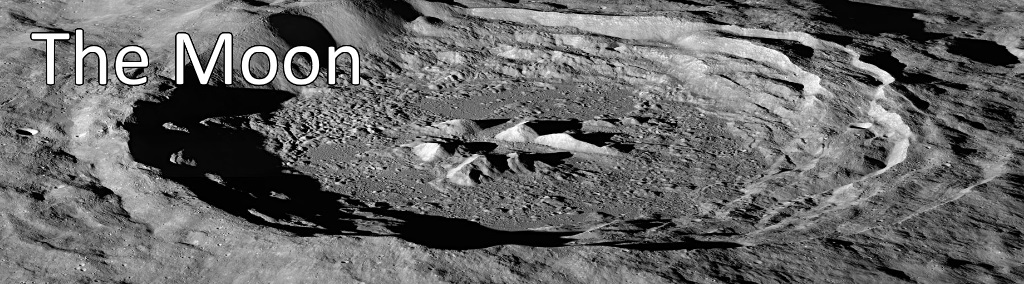 The Moon is a waxing gibbous, visible to the southeast in early evening, and up for most of the night.
The full Moon occurs on Apr. 19th, rising at sunset, visible high in the sky around midnight, and visible all night long.
After the 19th, the Moon will be a waning gibbous, rising after sunset, visible high in the sky after midnight, and visible to the southwest after sunrise.
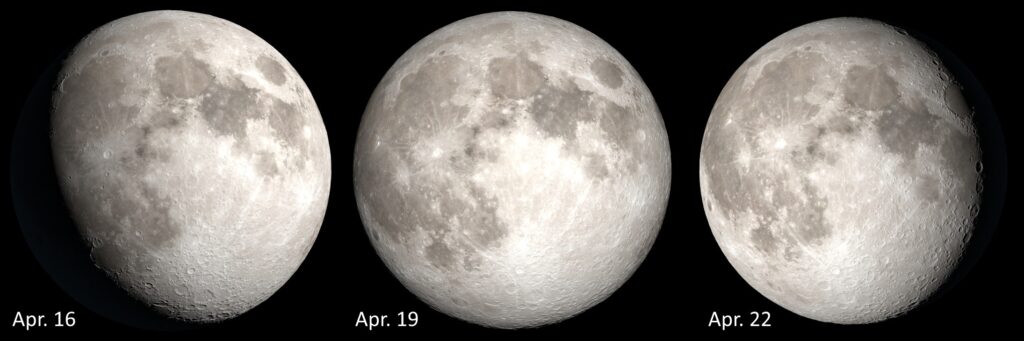 The Moon from Apr. 16-22, 2019. Visualizations by Ernie Wright / NASA’s Scientific Visualization Studio.
Moon News
As I was writing this post:
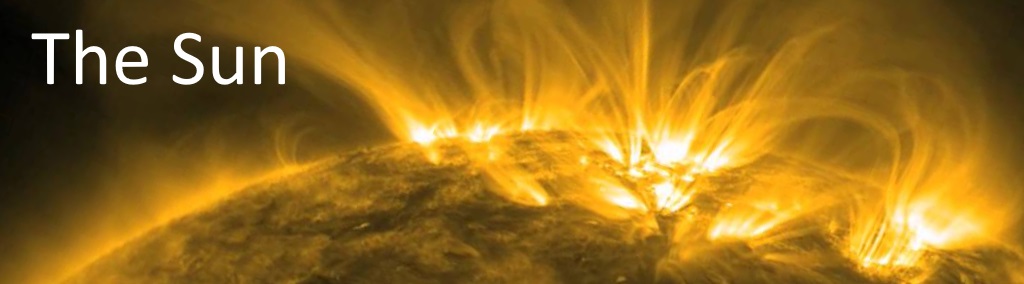
AR2738 continues to rotate across the face of the Sun, coronal loops following it; in previous days the region was blowing off multiple B-class solar flares, but now it appears to be quieting down. Astrophographer Marty Wise took this beautiful image of AR2738 showing a “light bridge” crossing the spot!
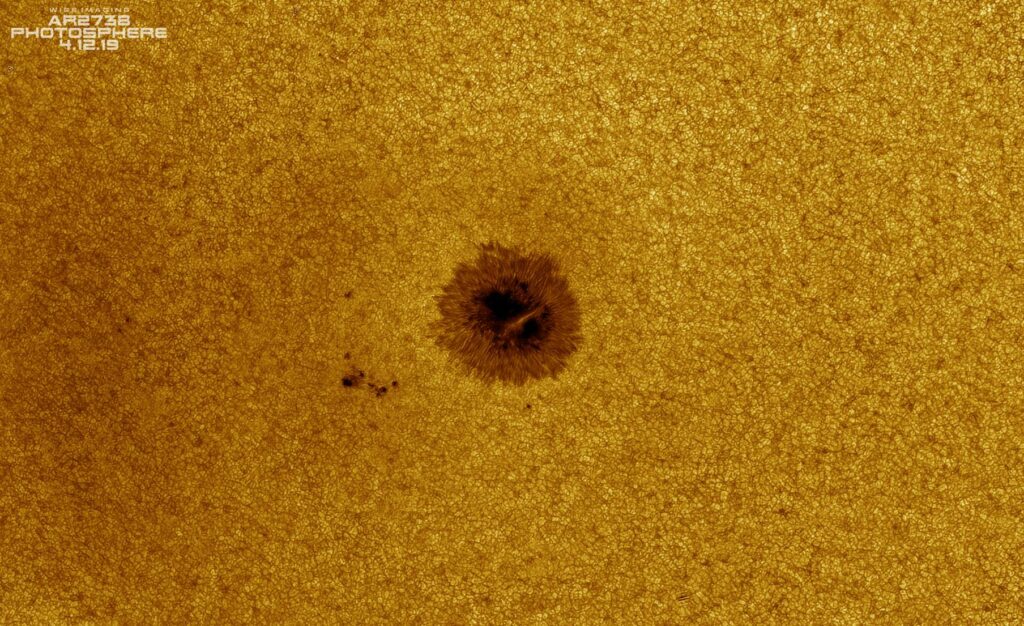 AR 2738 with light bridge. Credit: Marty Wise
The northern coronal hole remains closed, and it appears as if the southern hole has greatly diminished.
Light prominence activity around the Sun’s limb; you can see a few things being spewed out of AR2738 over the last couple days..
The solar wind speed is 381.9 km/sec (↓), with a density of 2.1 protons/cm3 (↓).
 Animated LASCO C2 Coronograph showing the solar corona above the Sun’s limb (the white circle). Credit: NASA/JPL-Caltech
You can create your own time-lapse movies of the Sun here: AIA/HMI Browse Data.
You can browse all the SDO images of the Sun from 2010 to the present here: Browse SDO archive.
Sun News
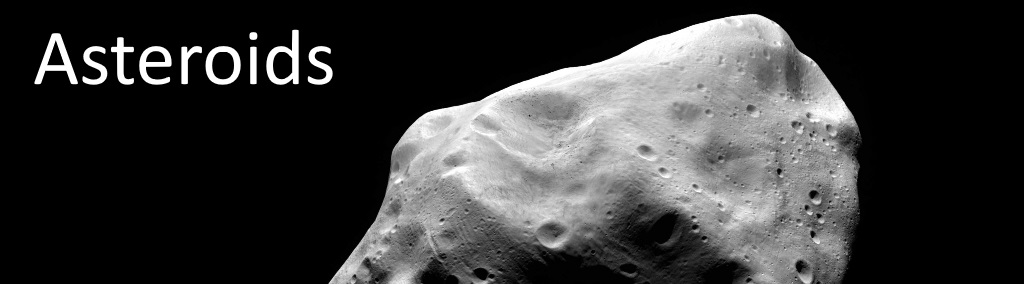 Upcoming Earth-asteroid encounters:
| Asteroid |
Date(UT)
|
Miss Distance
|
Velocity (km/s)
|
Diameter (m)
|
| 2012 XO134 |
2019-Apr-18
|
14.8 LD
|
11
|
56
|
| 2019 FN2 |
2019-Apr-18
|
4.1 LD
|
7.8
|
68
|
| 522684 |
2019-Apr-19
|
19 LD
|
11.5
|
214
|
| 2019 GM |
2019-Apr-21
|
19.4 LD
|
10.4
|
37
|
| 2019 FV2 |
2019-Apr-22
|
15.6 LD
|
2.3
|
33
|
| 2019 GF1 |
2019-Apr-27
|
4.7 LD
|
1.9
|
11
|
| 2018 KK1 |
2019-May-05
|
13.9 LD
|
13.9
|
71
|
| 2017 RC |
2019-May-09
|
14.5 LD
|
10.6
|
9
|
| 2008 HS3 |
2019-May-09
|
14.6 LD
|
5.3
|
162
|
| 2018 VX8 |
2019-May-12
|
6.2 LD
|
15.5
|
118
|
| 2019 GT1 |
2019-May-17
|
6.1 LD
|
4
|
36
|
| 2012 KT12 |
2019-May-18
|
3.3 LD
|
3.9
|
20
|
| 2015 KQ18 |
2019-May-25
|
10.7 LD
|
13.1
|
30
|
| 66391 |
2019-May-25
|
13.5 LD
|
21.5
|
1780
|
| 2003 LH |
2019-May-28
|
15.6 LD
|
7.4
|
32
|
| 2011 HP |
2019-May-30
|
12.3 LD
|
8.4
|
135
|
| 2014 MF18 |
2019-Jun-06
|
8.8 LD
|
3
|
22
|
Notes: LD means “Lunar Distance.” 1 LD = 384,401 km, the distance between Earth and the Moon. Table from SpaceWeather.com
Potentially hazardous asteroids: 1967 (last updated Feb. 26, 2019)
Minor Planets discovered: 794,460 (+338)
Asteroid News
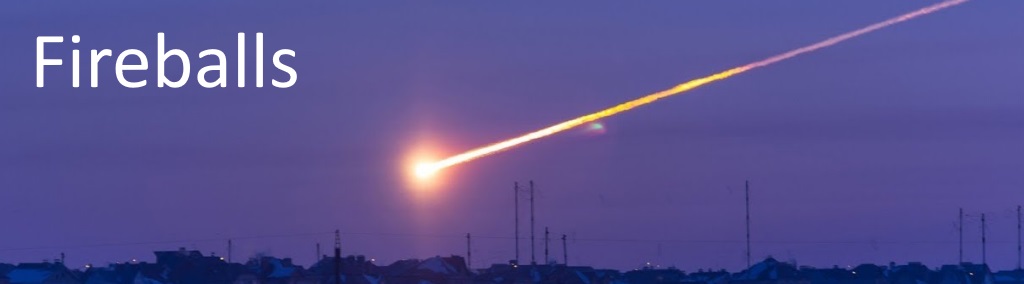
Keep an eye out for meteors and fireballs during the Lyrid meteor shower this week!
Active from April 16th to April 28th, 2019
The Lyrids are a medium strength shower that usually produces good rates for three nights centered on the maximum. These meteors also usually lack persistent trains but can produce fireballs. These meteors are best seen from the northern hemisphere where the radiant is high in the sky at dawn. Activity from this shower can be seen from the southern hemisphere, but at a lower rate.
Shower details – Radiant: 18:04 +34° – ZHR: 18 – Velocity: 30 miles/sec (medium – 48.4km/sec) – Parent Object: C/1861 G1 (Thatcher)
Next Peak – The Lyrids will next peak on the Apr 21-22, 2019 night. On this night, the moon will be 92% full. – American Meteor Society
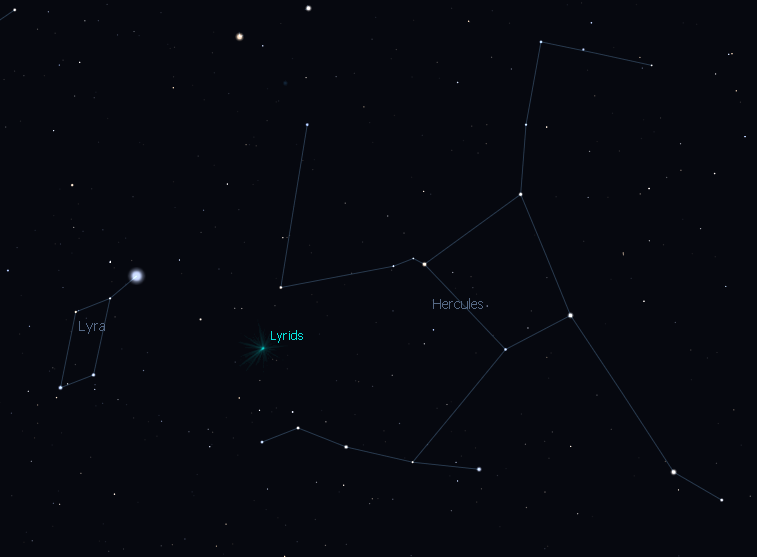 Lyrids Meteor Shower Radiant. Credit: Stellarium
On Apr. 15, 2019, the NASA All Sky Fireball Network reported 8 fireballs.
(8 sporadics)
 In this diagram of the inner solar system, all of the fireball orbits intersect at a single point–Earth. The orbits are color-coded by velocity, from slow (red) to fast (blue). From: Spaceweather.com
Fireball News
A Comet over Notre Dame, 1858
I saw this illustration posted numerous times on Twitter after part of Notre Dame burned down on April 15, 2019. My wife and I have not visited Paris; my daughter, who visited Paris a couple years ago, is devastated!
 Contemporary illustration of Donati’s Comet (C/1858 L1) over Notre Dame, 4 October 1858 – published in the fifth edition of Amédée Guillemin’s “Le Ciel: Notions D’Astronomie” (1877).
 This is the position of the planets and a couple bodies in the solar system:
Solar System News
OSIRIS-REx – Observing Asteroid Bennu from Oblique Angles
Juno at Jupiter
JAXA HAYABUSA2 – Performs First Collision Experiment with an Asteroid
From the History Books: Deep Impact’s Impact Experiment on Comet Tempel 1 in 2005
#/media/File:HRIV_Impact.gif) Flyby spacecraft Deep Impact shows the flash that occurred when comet Tempel 1 ran over the spacecraft’s impactor probe. It was taken by the flyby craft’s High Resolution Instrument, Visual CCD camera (HRIV) over a period of about 40 seconds. Black borders are the result of image stabilization. Animation recreated from the original raw encounter data (FITS images) downloaded from Small Bodies Mission. Credit: Paul Stephen Carlin / Public Domain
Flyby spacecraft Deep Impact shows the flash that occurred when comet Tempel 1 ran over the spacecraft’s impactor probe. It was taken by the flyby craft’s High Resolution Instrument, Visual CCD camera (HRIV) over a period of about 40 seconds. Black borders are the result of image stabilization. Animation recreated from the original raw encounter data (FITS images) downloaded from Small Bodies Mission. Credit: Paul Stephen Carlin / Public DomainMars Insight – Investigations into Drill Problem Continue
Climate
Earth Climate Observing Satellites from NASA’s Eyes on the Earth app – you can see info on each satellite, and overlay and animate satellite data on the globe.
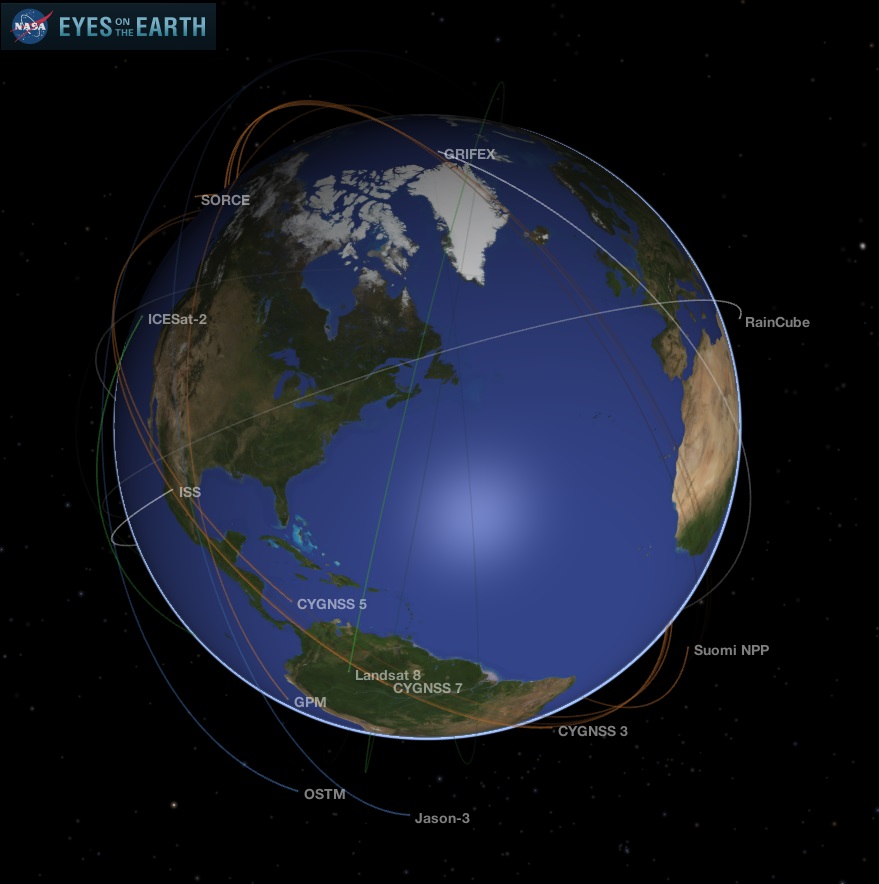 Earth observing satellites, Apr. 16, 2019. Credit: NASA Eyes on the Earth / Bob Trembley.
TESS numbers are starting to climb!
Data from the NASA Exoplanet Archive
Exoplanet News
Exoplanet Artwork by Bob Trembley
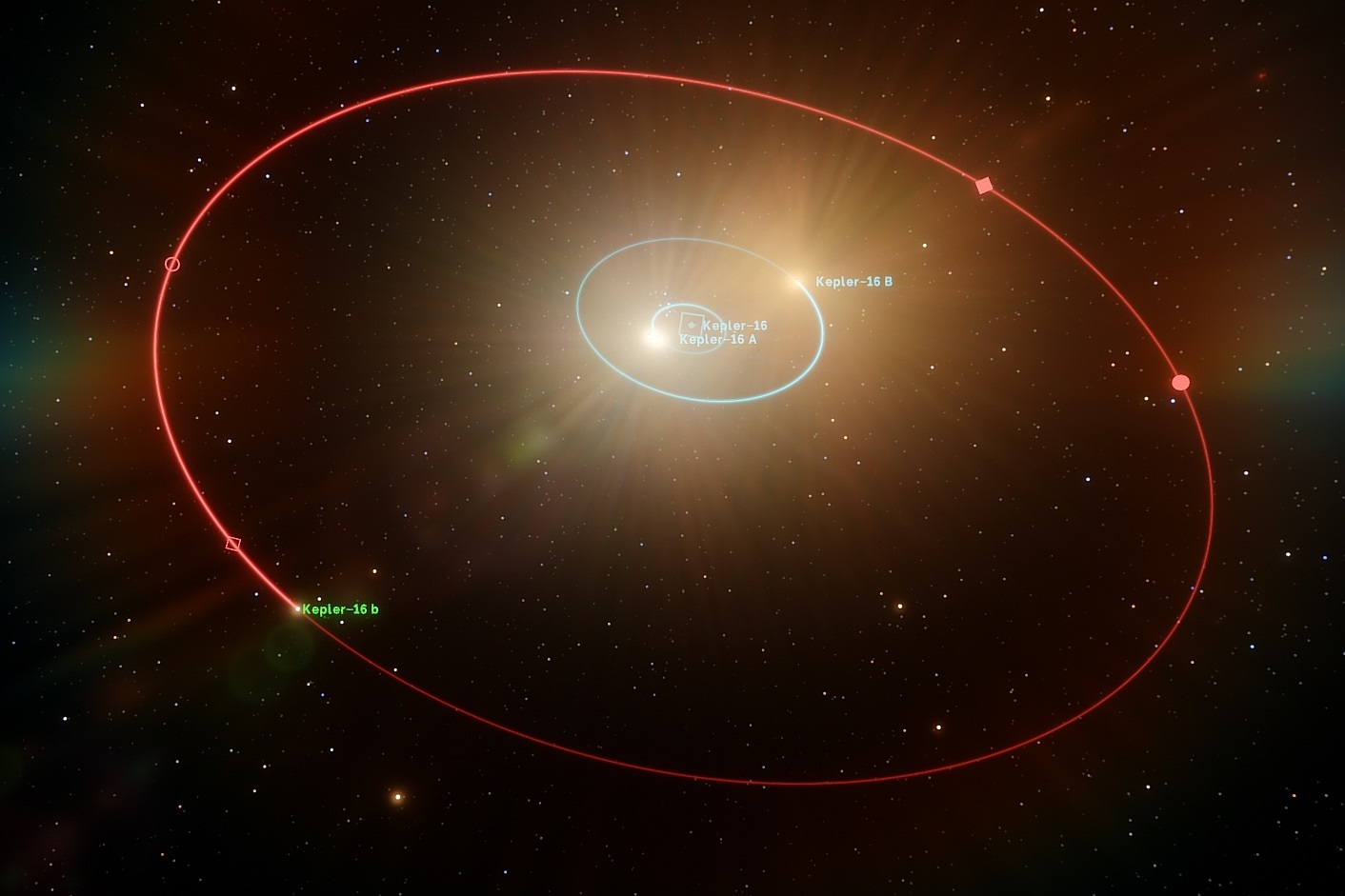
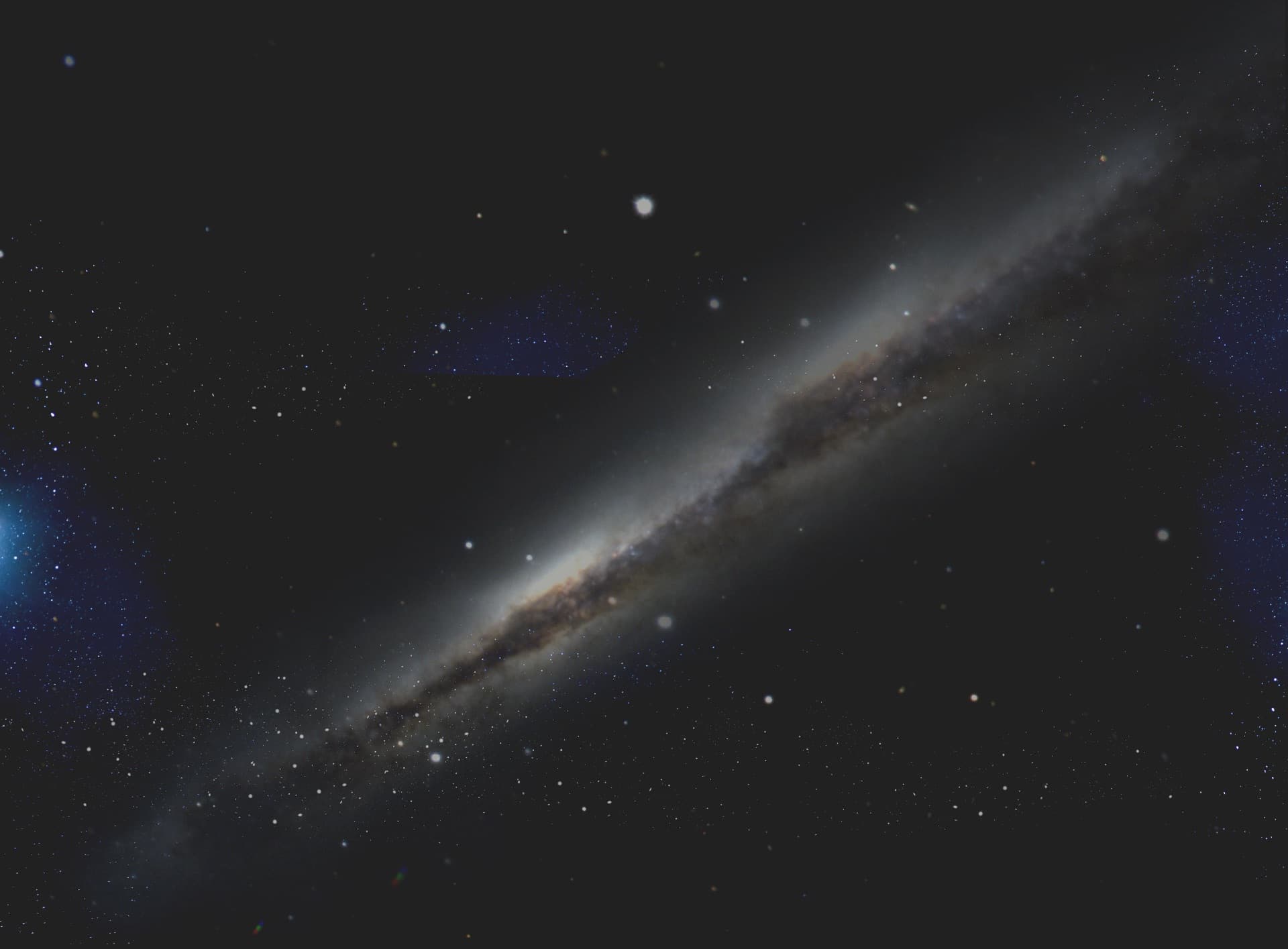
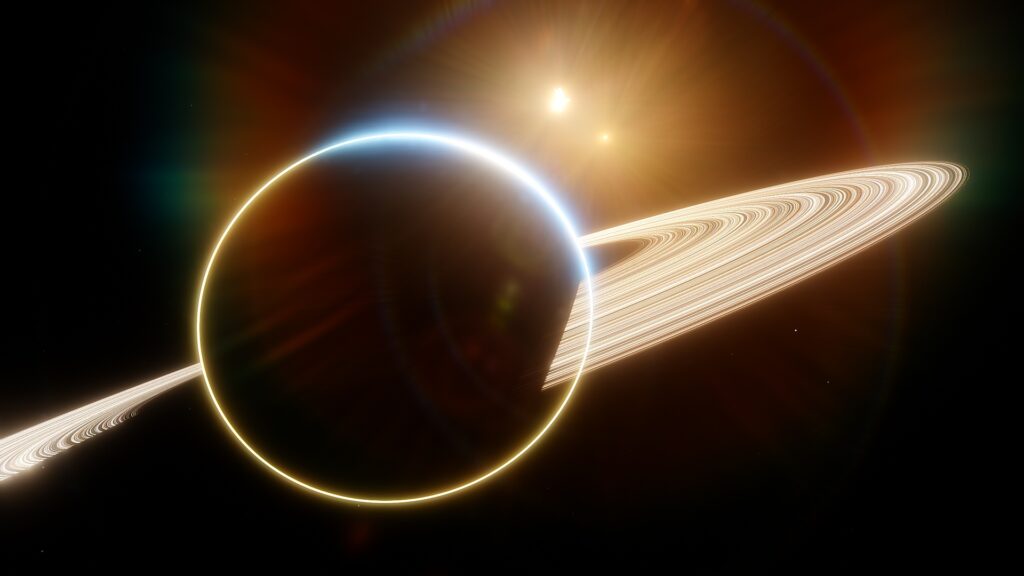 Exoplanet Artwork – Kepler-16b. Credit: Space Engine / Bob Trembley.
Kepler-16 b – The existence of a world with a double sunset, as portrayed in the film Star Wars more than 30 years ago, is now scientific fact. NASA’s Kepler mission has made the first unambiguous detection of a circumbinary planet – a planet orbiting two stars – 200 light-years from Earth.
Unlike Star Wars’ Tatooine, the planet is cold, gaseous and not thought to harbor life, but its discovery demonstrates the diversity of planets in our galaxy. Previous research has hinted at the existence of circumbinary planets, but clear confirmation proved elusive. Kepler detected such a planet, known as Kepler-16b, by observing transits, where the brightness of a parent star dims from the planet crossing in front of it.
[Read More: NASA’s Kepler Mission Discovers a World Orbiting Two Stars]