The constellation Orion is moving slowly towards the west each evening; the star Betelgeuse has been dimming since last year, and is no longer in the top 25 brightest stars – which several of my astronomer friends have commented is “just weird!”
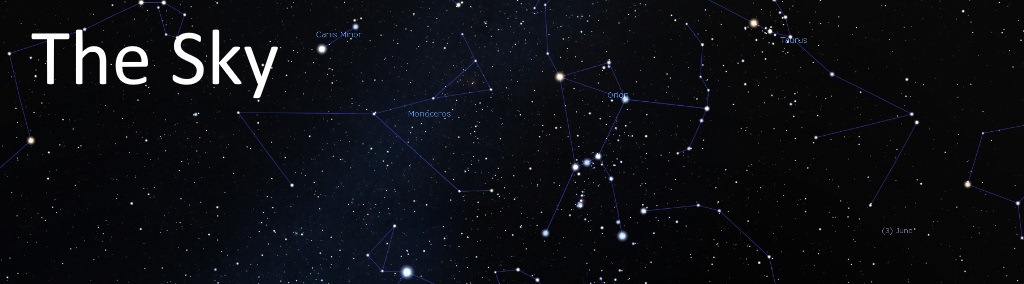
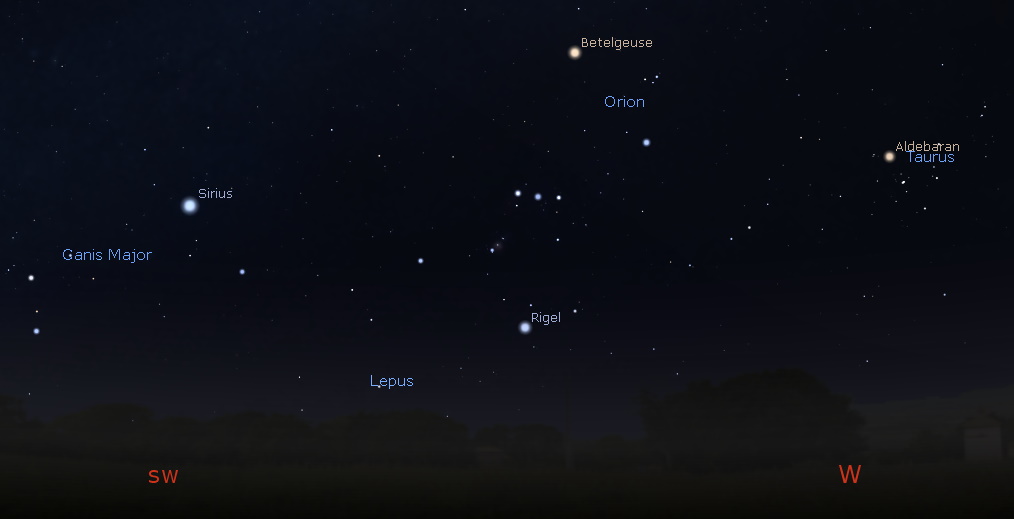 Orion appears west-southwestern sky at midnight this week. Credit: Stellarium / Bob Trembley.
As I was writing this post, I saw on SpaceWeather.com that apparently the dimming of Betelgeuse has stopped.
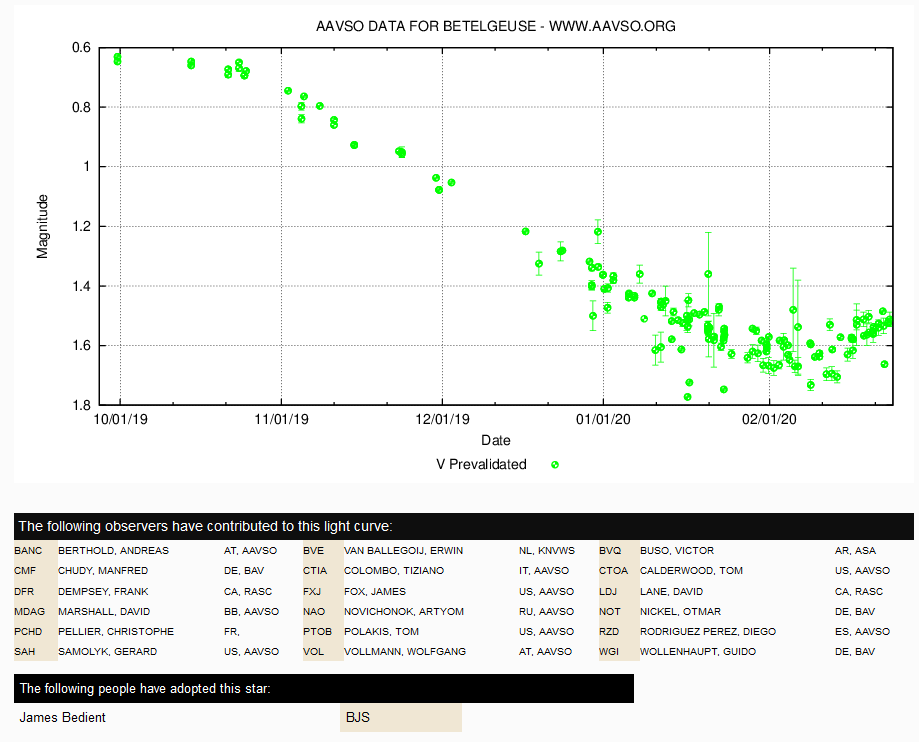 Betelgeuse hit bottom during the week of Feb. 7-13th with a magnitude slightly greater than +1.6. Based on observations, Betelgeuse has apparently stopped dimming and has started to slowly brighten. Credit: American Association of Variable Star Observers (AAVSO)
Predawn observers have three planets to choose from above the southeastern horizon: Saturn, Jupiter and Mars.
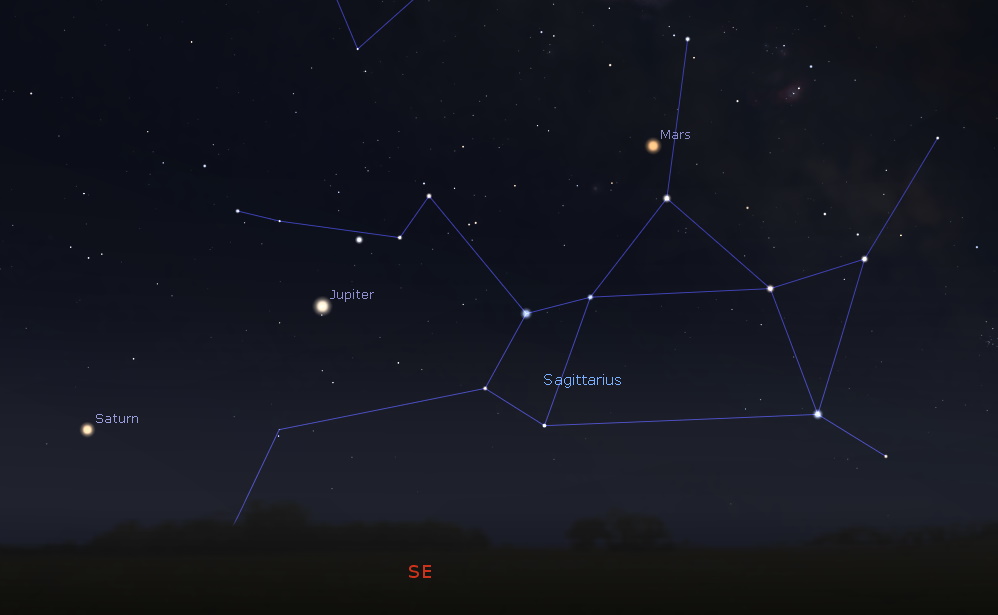 Saturn, Jupiter and Mars appear across the southeastern sky at 6:00 AM this week. Credit: Stellarium / Bob Trembley.
The crescent Moon joins Venus above the western horizon at dusk from February 25th – 28th.


The Moon appears near the star Aldebaran at 10:00 PM on March 1st – 2nd.
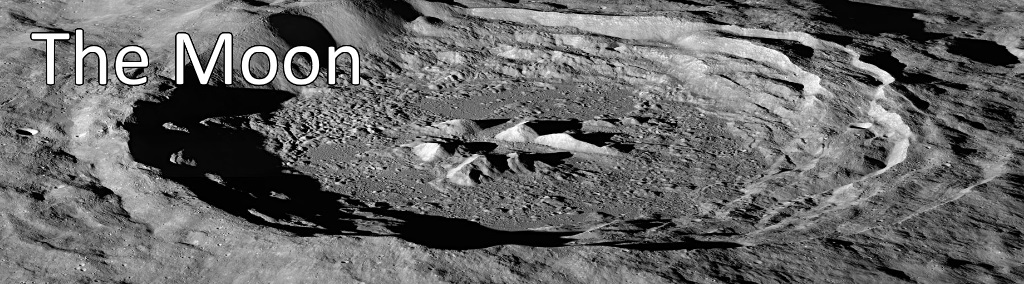
The Moon is a waxing crescent, visible toward the southwest in early evening.
The first quarter Moon occurs on March 2nd, it will be visible high in the southern sky in early evening.
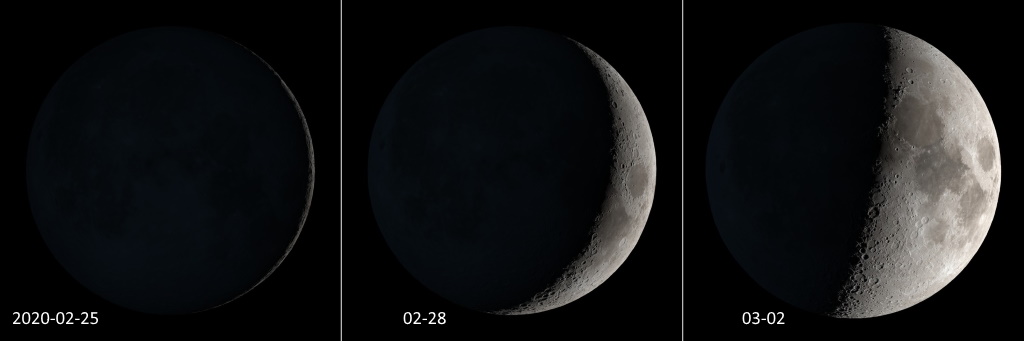 The Moon from 2020-02-25 – 2020-03-02. Visualizations by Ernie Wright / NASA’s Scientific Visualization Studio.
Click this image to go to the NASA 2020 Moon Phase and Libration site. Click the image of the Moon on that site to download a high-rez image of the current Moon phase with the names of craters and other features shown – many along the terminator.
Moon News: Historic NASA Mathematician Katherine Johnson Dies at Age 101
The Sun has been spot-free for 23 days. The northern coronal hole remains diminished, while the southern coronal hole remains wide open. The Solar Dynamics observatory was eclipsed by the Moon for the first few frames of the videos below.
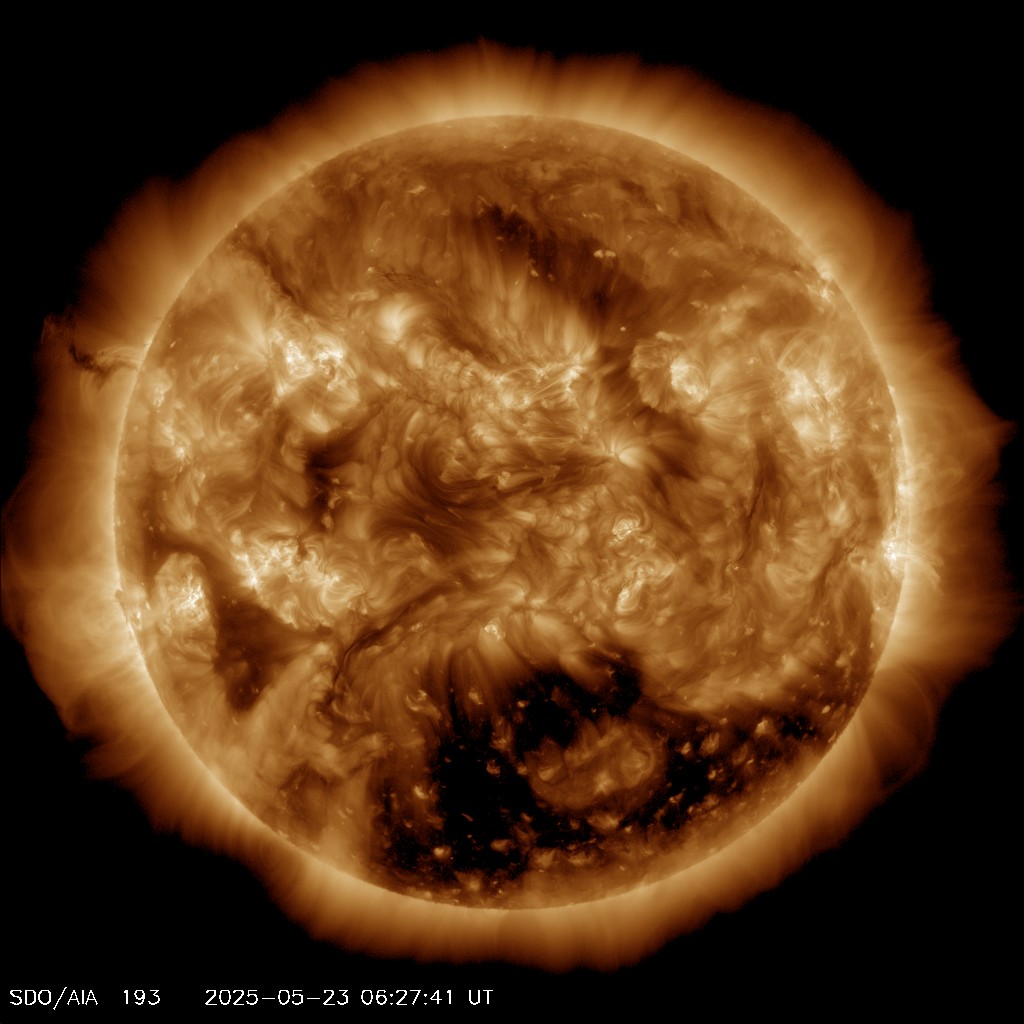
The Sun seen in 193 angstroms (extreme ultraviolet) Feb. 24, 2020:
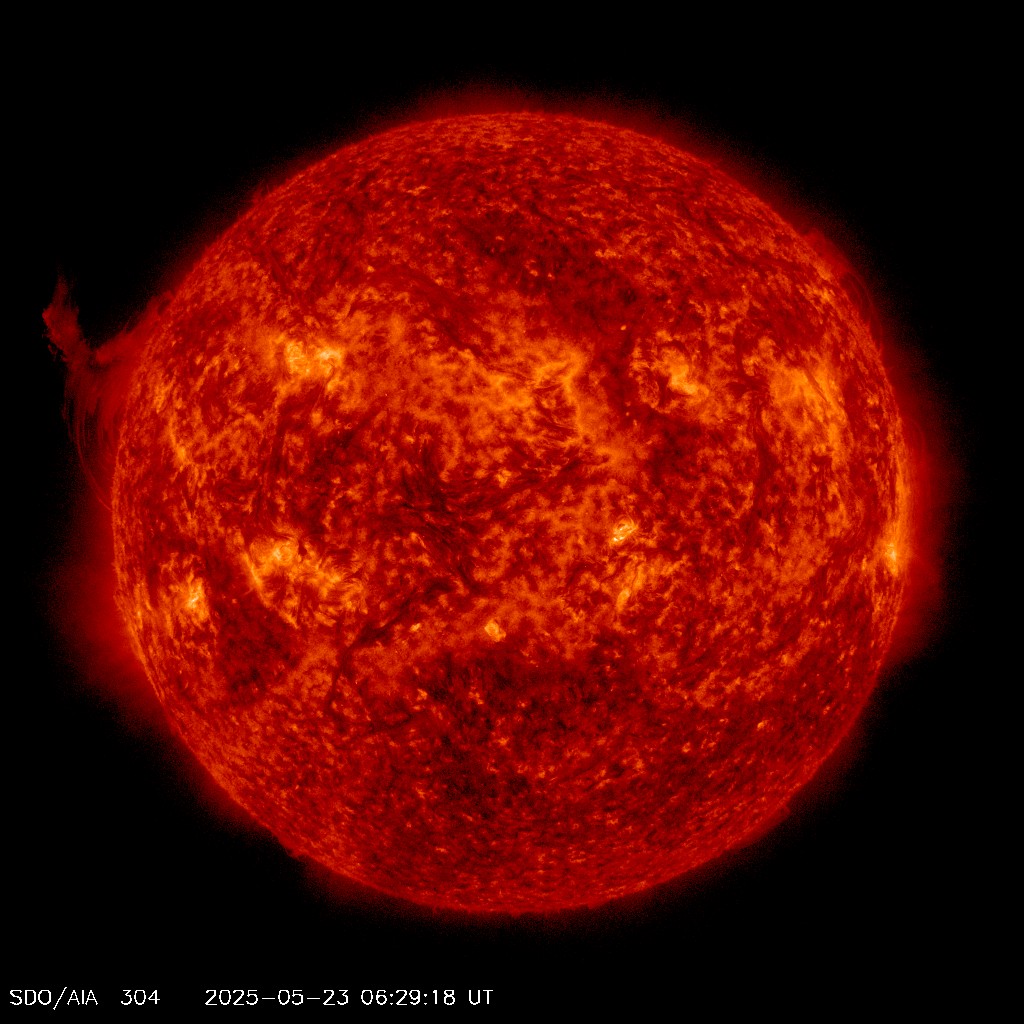
Some beautiful large prominences on the Sun’s limb over the last several days!
The Sun seen in 304 angstroms (extreme ultraviolet) Feb. 24, 2020:
You can view the Sun in near real-time, in multiple frequencies here: SDO-The Sun Now.
You can create your own time-lapse movies of the Sun here: AIA/HMI Browse Data.
You can browse all the SDO images of the Sun from 2010 to the present here: Browse SDO archive.
Here’s a still of the SDO eclipse image:
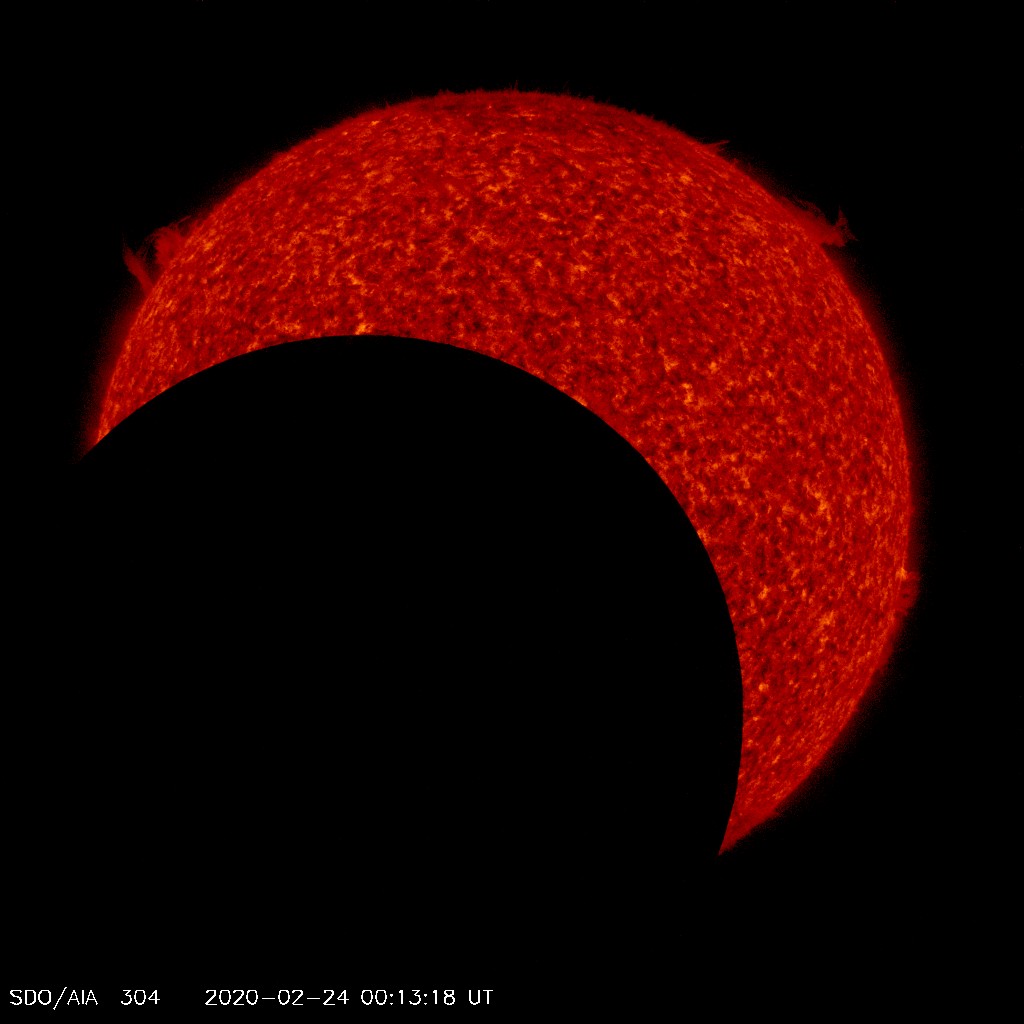 The Sun eclipsed by the Moon on 2020-02-24 as seen by NASA’s Solar Dynamics Observatory. Credit: NASA/SDO and the AIA, EVE, and HMI science teams
Facebook: SolarActivity
https://www.facebook.com/photo.php?fbid=3295119737169464&set=gm.3009076542437003&type=3&theater&ifg=1
Solar Corona
Solar wind speed is 353.8 km/sec (↓), with a density of 1.8 protons/cm3 (↓↓) at 0947 UT.
Near real-time animation of the corona and solar wind from the Solar & Heliospheric Observatory (SOHO):
 Animated LASCO C2 Coronograph showing the solar corona above the Sun’s limb (the white circle). Credit: NASA/JPL-Caltech-SOHO
Sun News
Potentially hazardous asteroids: 2018 (last updated Oct. 1, 2019)
Total Minor Planets discovered: 942,500 (+8358!!)
Upcoming Earth-asteroid encounters:
| Asteroid |
Date(UT)
|
Miss Distance
|
Velocity (km/s)
|
Diameter (m)
|
| 2020 DT2 |
2020-Feb-25
|
5.2 LD
|
11.9
|
11
|
| 2012 DS30 |
2020-Feb-26
|
12.3 LD
|
5.4
|
22
|
| 2020 DZ1 |
2020-Feb-27
|
7.4 LD
|
14.1
|
56
|
| 2020 DM2 |
2020-Feb-28
|
5.9 LD
|
4.9
|
12
|
| 2015 BK509 |
2020-Feb-29
|
18.7 LD
|
12.5
|
118
|
| 2020 DV1 |
2020-Feb-29
|
10.5 LD
|
15.6
|
53
|
| 2017 BM123 |
2020-Mar-01
|
10.5 LD
|
8.1
|
65
|
| 2018 RF6 |
2020-Mar-10
|
11.2 LD
|
12.6
|
36
|
| 2020 CA3 |
2020-Mar-10
|
13.8 LD
|
6.3
|
30
|
| 2008 UB95 |
2020-Mar-11
|
18.5 LD
|
7.6
|
41
|
| 2018 GY |
2020-Mar-15
|
6.2 LD
|
9.5
|
39
|
| 2012 XA133 |
2020-Mar-27
|
17.4 LD
|
23.7
|
235
|
| 2010 GD35 |
2020-Mar-29
|
15.3 LD
|
12
|
43
|
| 2006 FH36 |
2020-Mar-30
|
11.3 LD
|
5.1
|
93
|
| 2019 GM1 |
2020-Apr-02
|
9 LD
|
4.2
|
14
|
| 2015 FC35 |
2020-Apr-04
|
10.5 LD
|
13.8
|
148
|
| 2019 HM |
2020-Apr-10
|
7.2 LD
|
3.2
|
23
|
| 363599 |
2020-Apr-11
|
19.2 LD
|
24.5
|
224
|
Notes: LD means “Lunar Distance.” 1 LD = 384,401 km, the distance between Earth and the Moon. Red highlighted entries are asteroids that either pass very close, or very large with high relative velocities to the Earth. Table from SpaceWeather.com
Asteroid News: Pallas Imaged Using Adaptive Optics on the Very Large Telescope
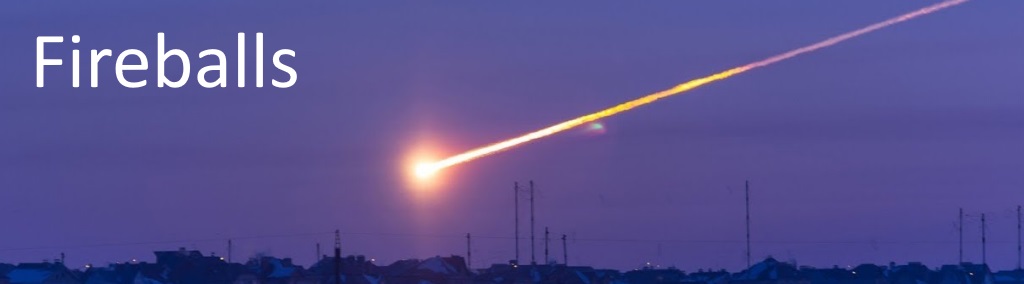 On Feb. 24, 2020, the NASA All Sky Fireball Network reported 6 fireballs.
(6 sporadics)
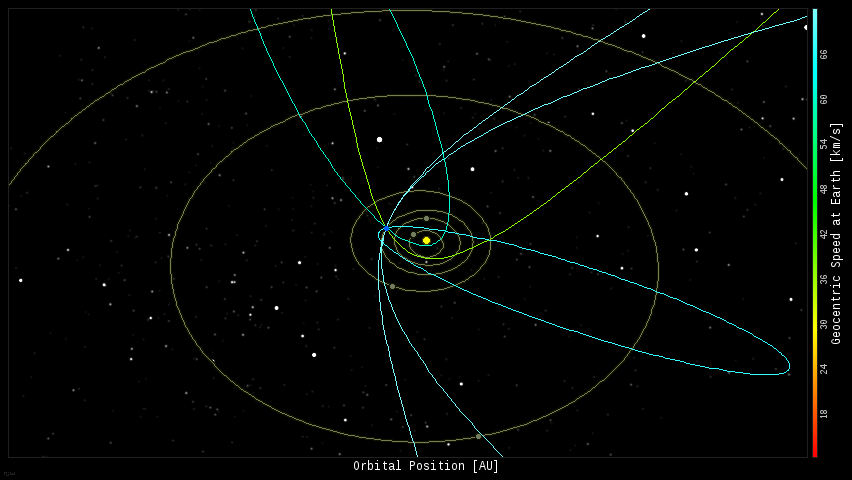 In this diagram of the inner solar system, all of the fireball orbits intersect at a single point–Earth. The orbits are color-coded by velocity, from slow (red) to fast (blue). From: Spaceweather.com
Fireball & Meteor News: Meteorite Strike May Have Killed a Man in India!
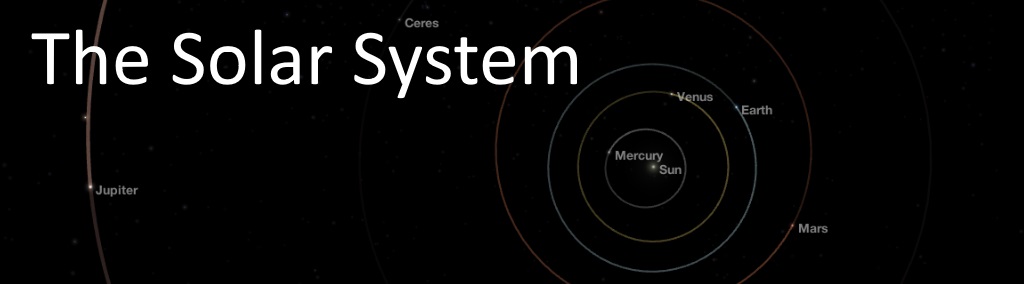 Position of the planets and a couple spacecraft in the inner solar system.
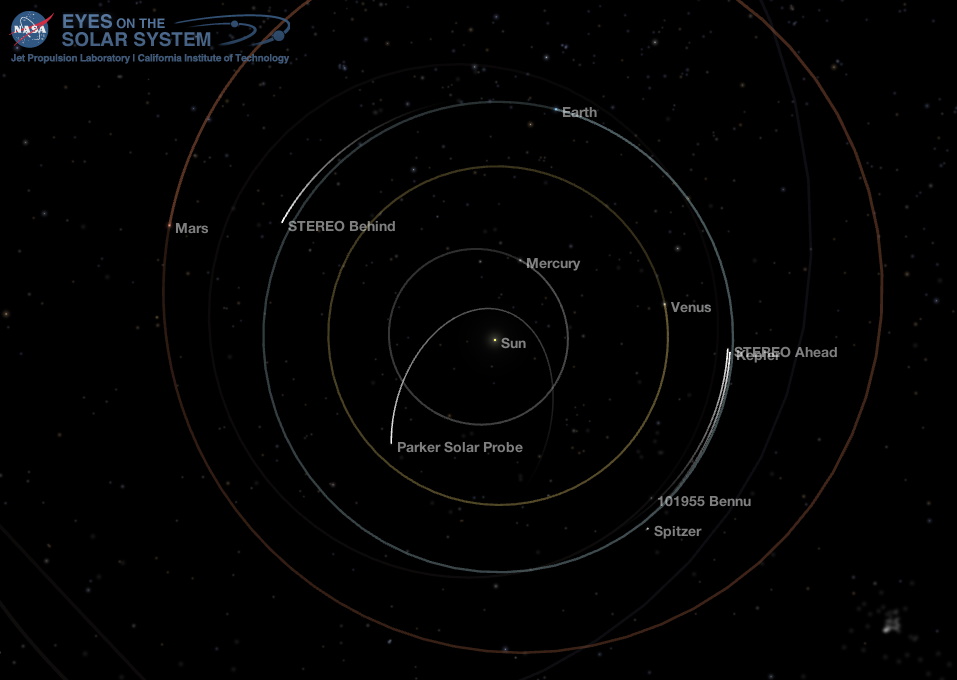 Position of the planets and a couple spacecraft in the inner solar system, 2020-02-25. Credit: NASA Eyes on the Solar System / Bob Trembley.
Position of the planets in the middle solar system – asteroid 4 Vesta is highlighted:
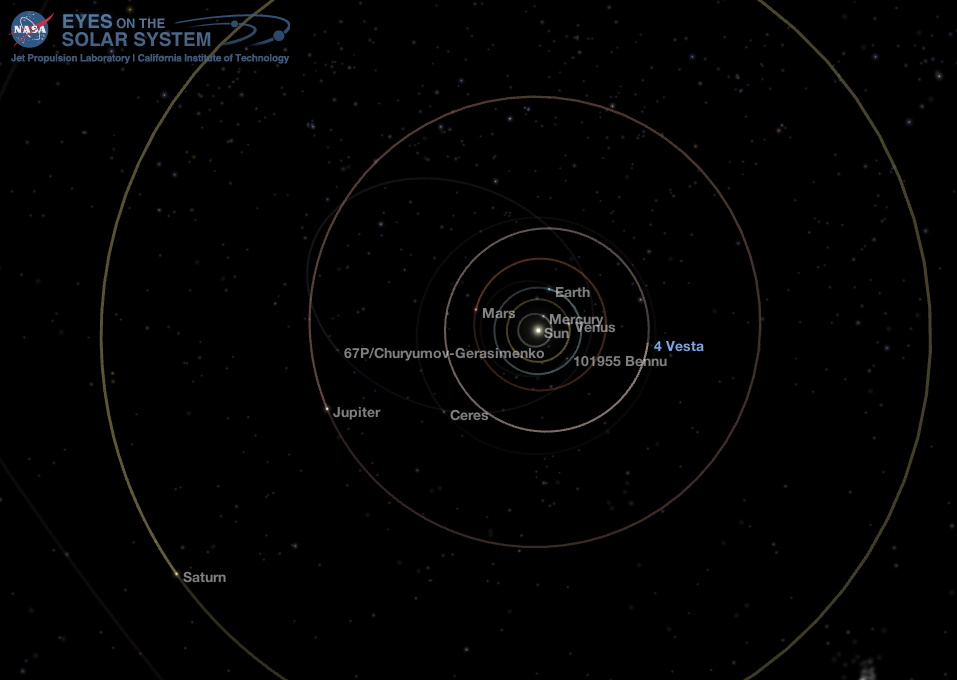 Position of the planets in the middle solar system, 2020-02-25. Credit: NASA Eyes on the Solar System / Bob Trembley.
4 Vesta
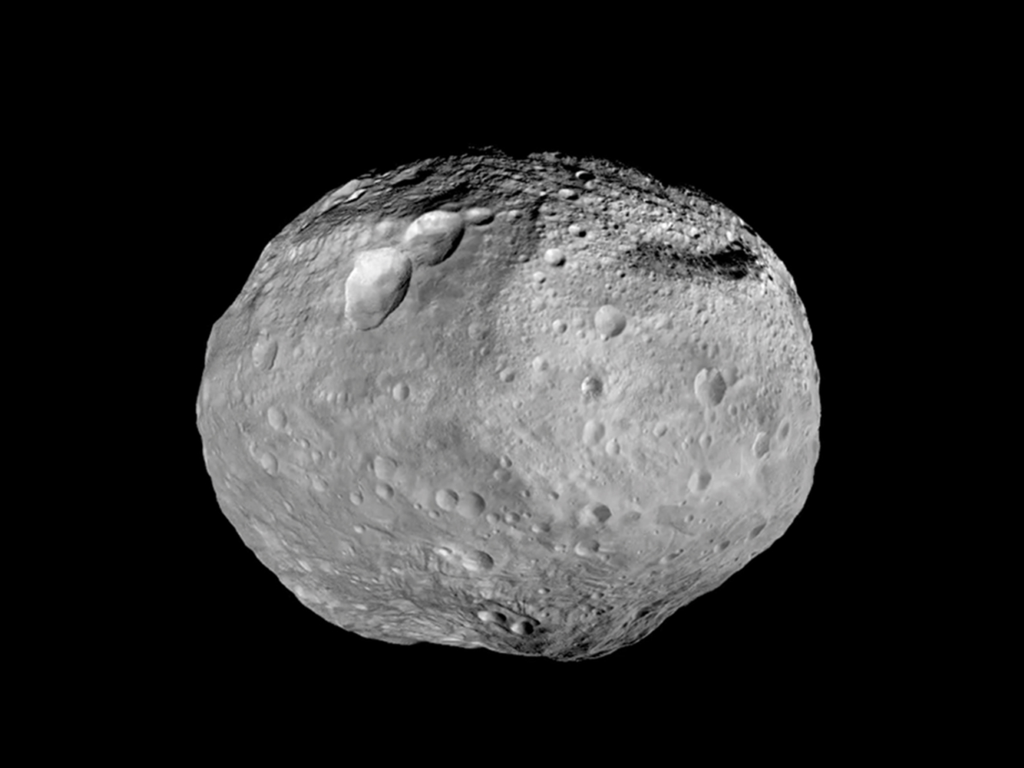 Asteroid 4 Vesta. Image credit: NASA/JPL-Caltech/UCAL/MPS/DLR/IDA
Vesta (minor-planet designation: 4 Vesta) is one of the largest objects in the asteroid belt, with a mean diameter of 525 kilometres (326 mi). It was discovered by the German astronomer Heinrich Wilhelm Matthias Olbers on 29 March 1807 and is named after Vesta, the virgin goddess of home and hearth from Roman mythology.
Vesta is the second-most-massive and probably the second-largest asteroid, after the dwarf planet Ceres, and contributes an estimated 9% of the mass of the asteroid belt. It is probably slightly larger than Pallas, but is about 25% more massive. Vesta is the only known remaining rocky protoplanet (with a differentiated interior) of the kind that formed the terrestrial planets. – Wikipedia
I covered Vesta and Ceres extensively in my series about NASA’s Dawn mission.
3D Model of Vesta – go ahead and grab-and-drag it with your mouse!
Position of the planets in the outer solar system:
 Position of the planets in the outer solar system, 2020-02-25. Credit: NASA Eyes on the Solar System / Bob Trembley.
OSIRIS-REx Asteroid Sample Return Mission
Juno Mission at Jupiter
International Space Station
Hubble Space Telescope
Climate

Data from the NASA Exoplanet Archive
* Confirmed Planets Discovered by TESS refers to the number planets that have been published in the refereed astronomical literature.
* TESS Project Candidates refers to the total number of transit-like events that appear to be astrophysical in origin, including false positives as identified by the TESS Project.
* TESS Project Candidates Yet To Be Confirmed refers to the number of TESS Project Candidates that have not yet been dispositioned as a Confirmed Planet or False Positive.
The Local Stellar Neighborhood
Continuing with my visual tour of nearby stars and their systems, we travel to Sirius, 8.44 light years distant.
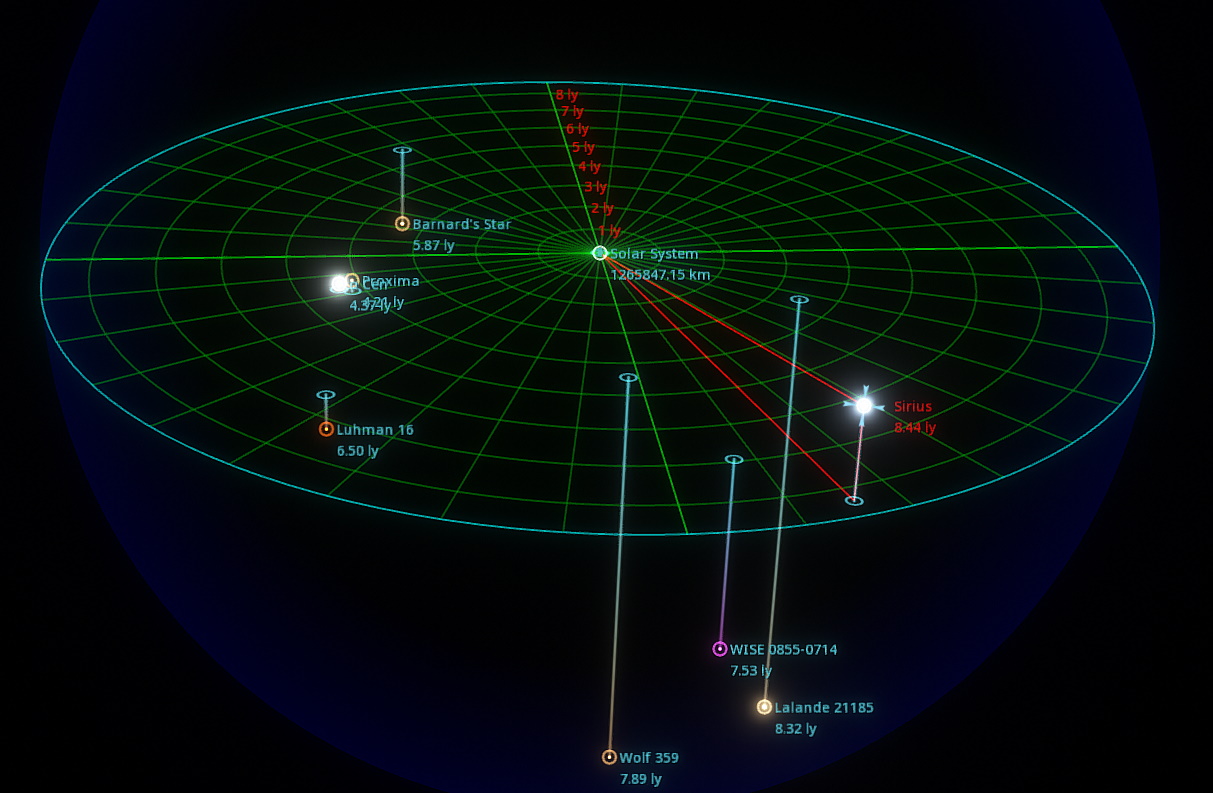 Distance to the Sirius star system from Sol; the plane (green) is aligned with the orientation of the Milky Way galaxy’s plane. Credit: SpaceEngine / Bob Trembley.
Sirius
Sirius (/ˈsɪri