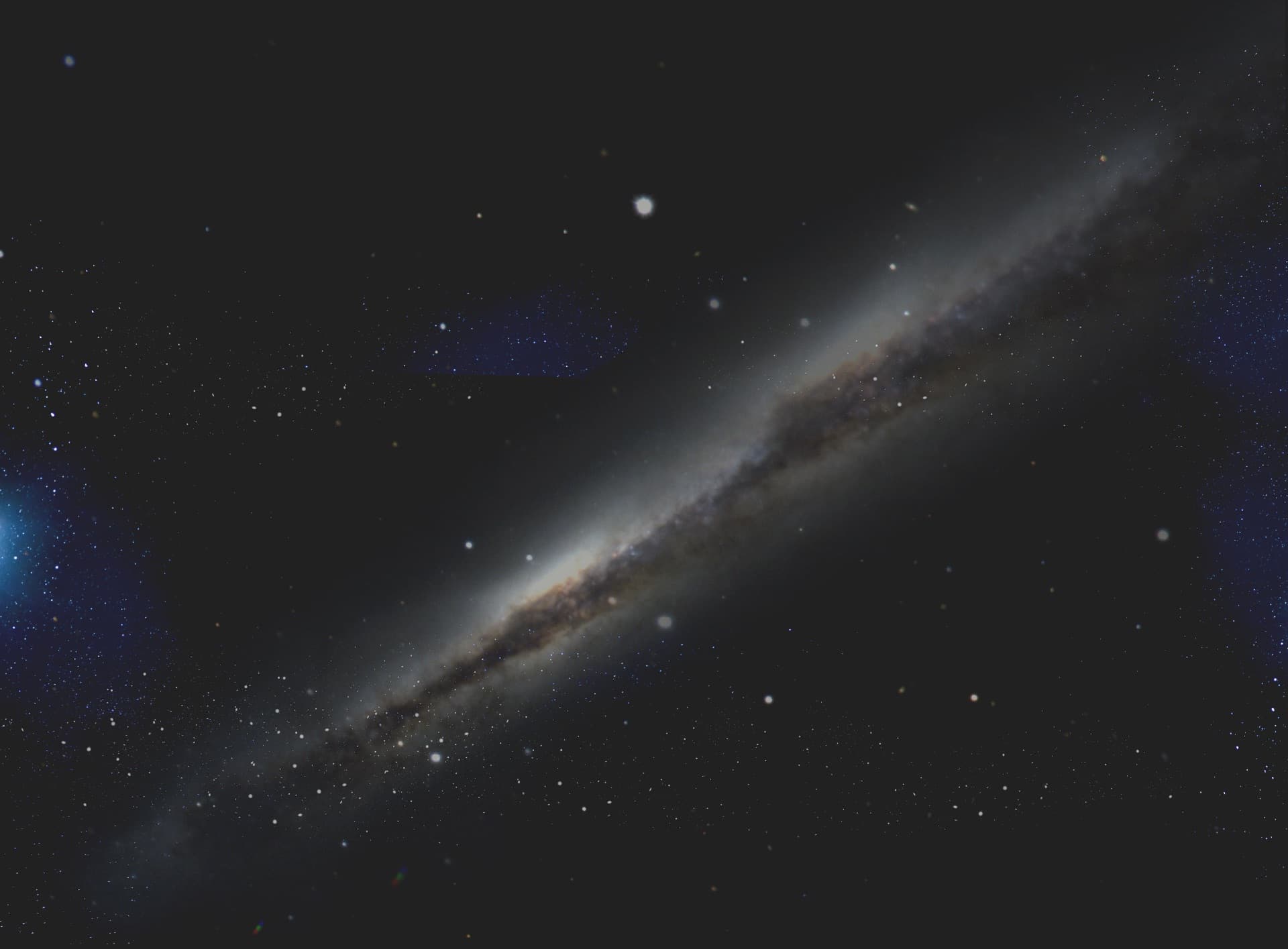
A beautiful thin waning crescent Moon was high in the southeastern sky as I saw my wife off to her second day of school this morning. The Moon will be lower and thinner at 6:00 AM for the next couple days.
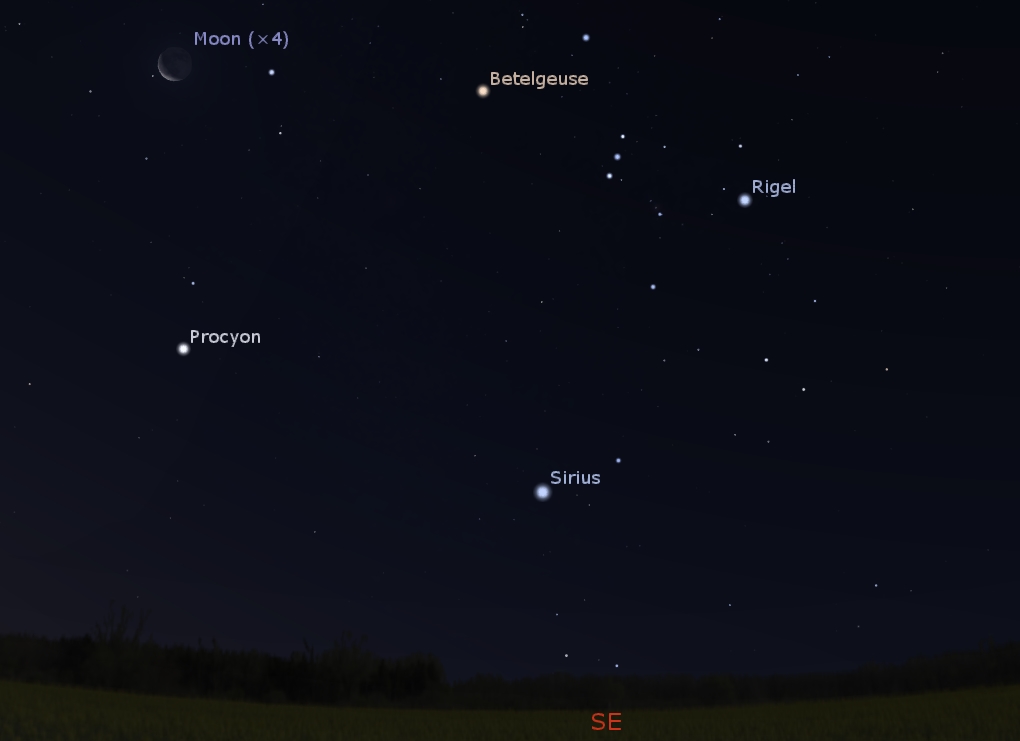 A thin waning crescent Moon east of the constellation Orion before dawn on Sept. 5, 28, 2018. Credit: Stellarium / Bob Trembley.
After dusk, the splash of planets across the southeastern sky continues to be free from the glare of the Moon this week; Jupiter will only be visible for a couple weeks before disappearing behind the Sun.
 Mars, Saturn and Jupiter in the south-southwestern sky shortly after 9:00 PM, Sept. 5, 2018. Credit: Stellarium / Bob Trembley.
Venus is very low above the southwestern horizon, and Jupiter appears higher and a bit towards the south at dusk.
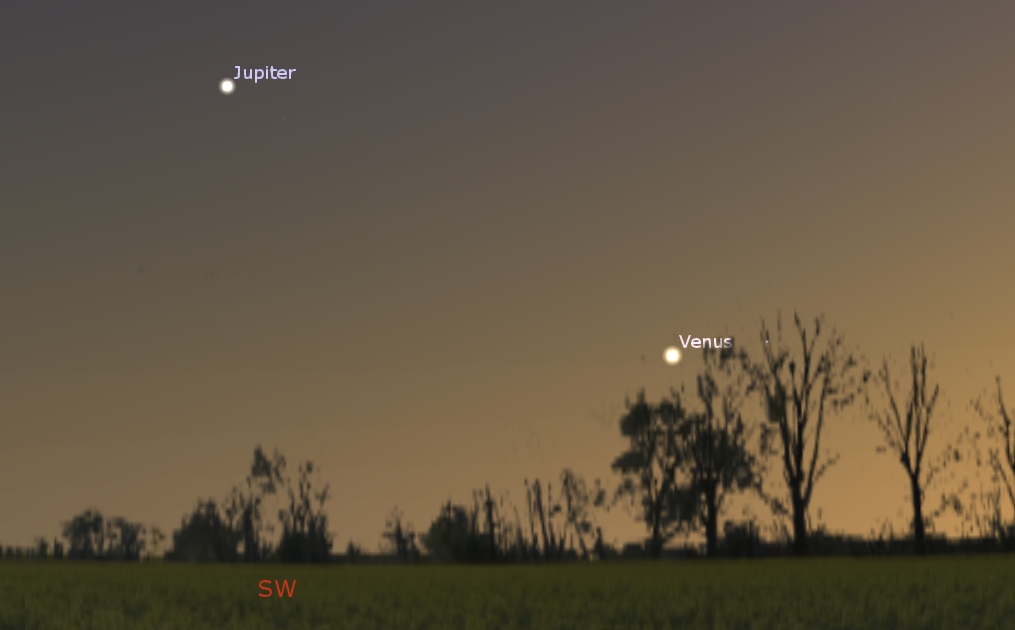 Jupiter and Venus in the southwestern sky at dusk, Sept. 5, 2018. Credit: Stellarium / Bob Trembley.
The Moon
The Moon is a waning crescent, visible in the eastern sky before dawn. The Moon will be new on September 9th. Next week the Moon will reappear in the southwestern sky as a waxing crescent at dusk.
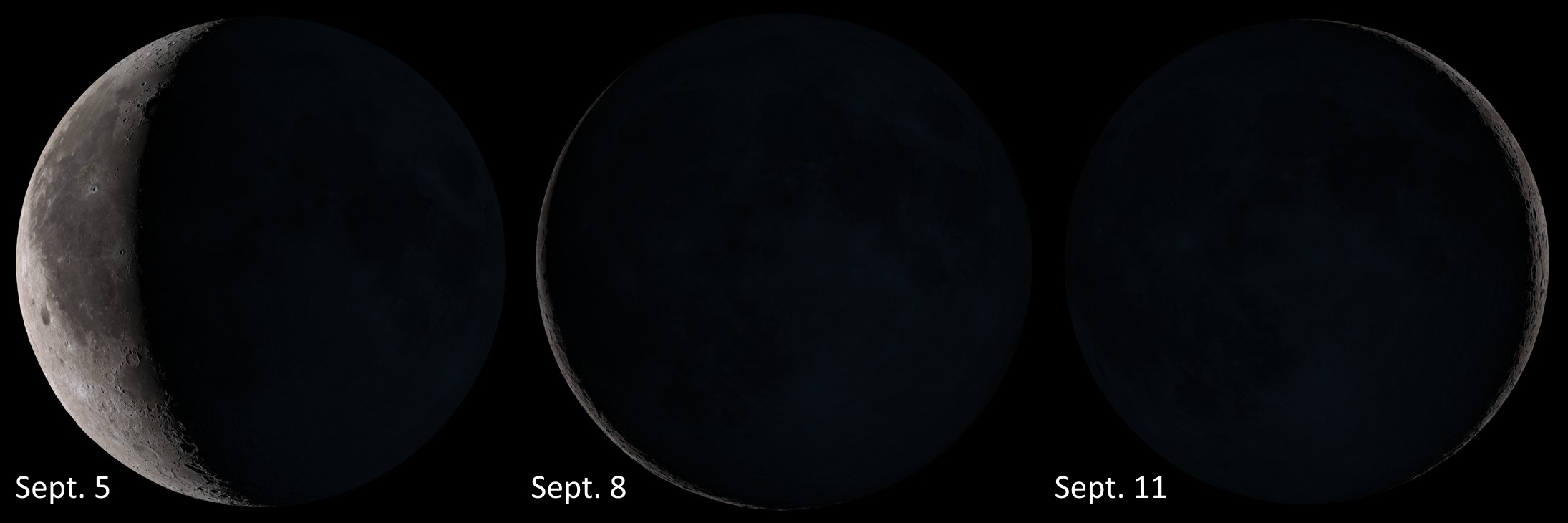 The Moon from Sept. 5-11, 2018. Visualizations by Ernie Wright
Observing Target: M92 – The Other Cluster in Hercules
“Messier 92 is a globular cluster of stars in the northern constellation of Hercules. It was discovered by Johann Elert Bode in 1777, then published in the Jahrbuch during 1779. The cluster was independently rediscovered by Charles Messier on March 18, 1781 and added as the 92nd entry in his catalogue. M92 is at a distance of about 26,700 light-years away from Earth.
M92 is one of the brighter globular clusters in the northern hemisphere, but it is often overlooked by amateur astronomers because of its proximity to the even more spectacular Messier 13. It is visible to the naked eye under very good conditions.”
~ From Wikipedia
In a small telescope, M92 appears as a small puff-ball of stars:
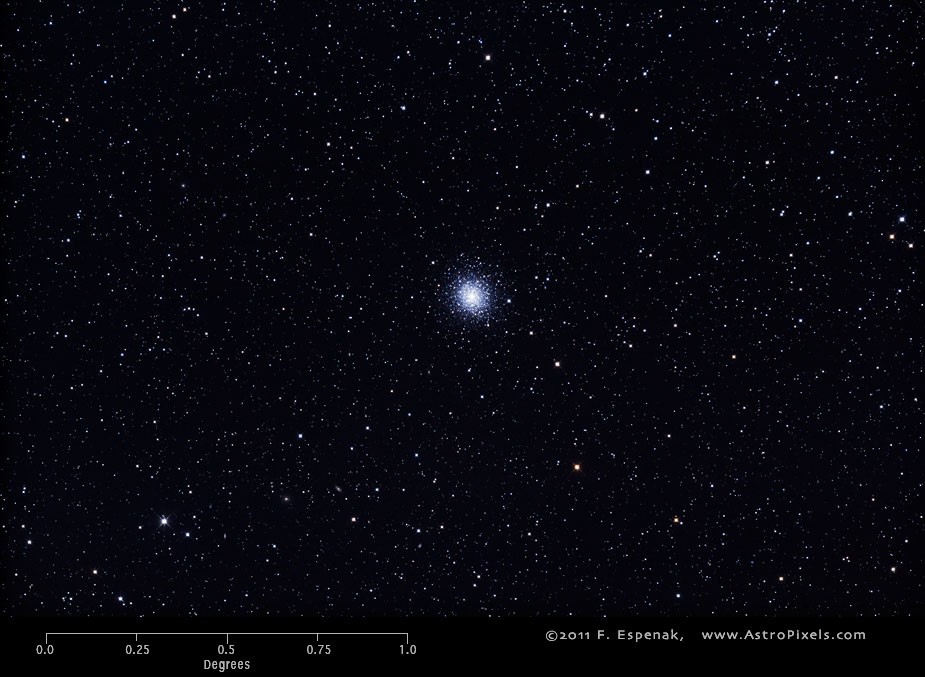 M92. Credit: Fred Espenak.
The Hubble Space Telescope shows M92 to be a beautiful swarm of hundreds of thousands of stars:
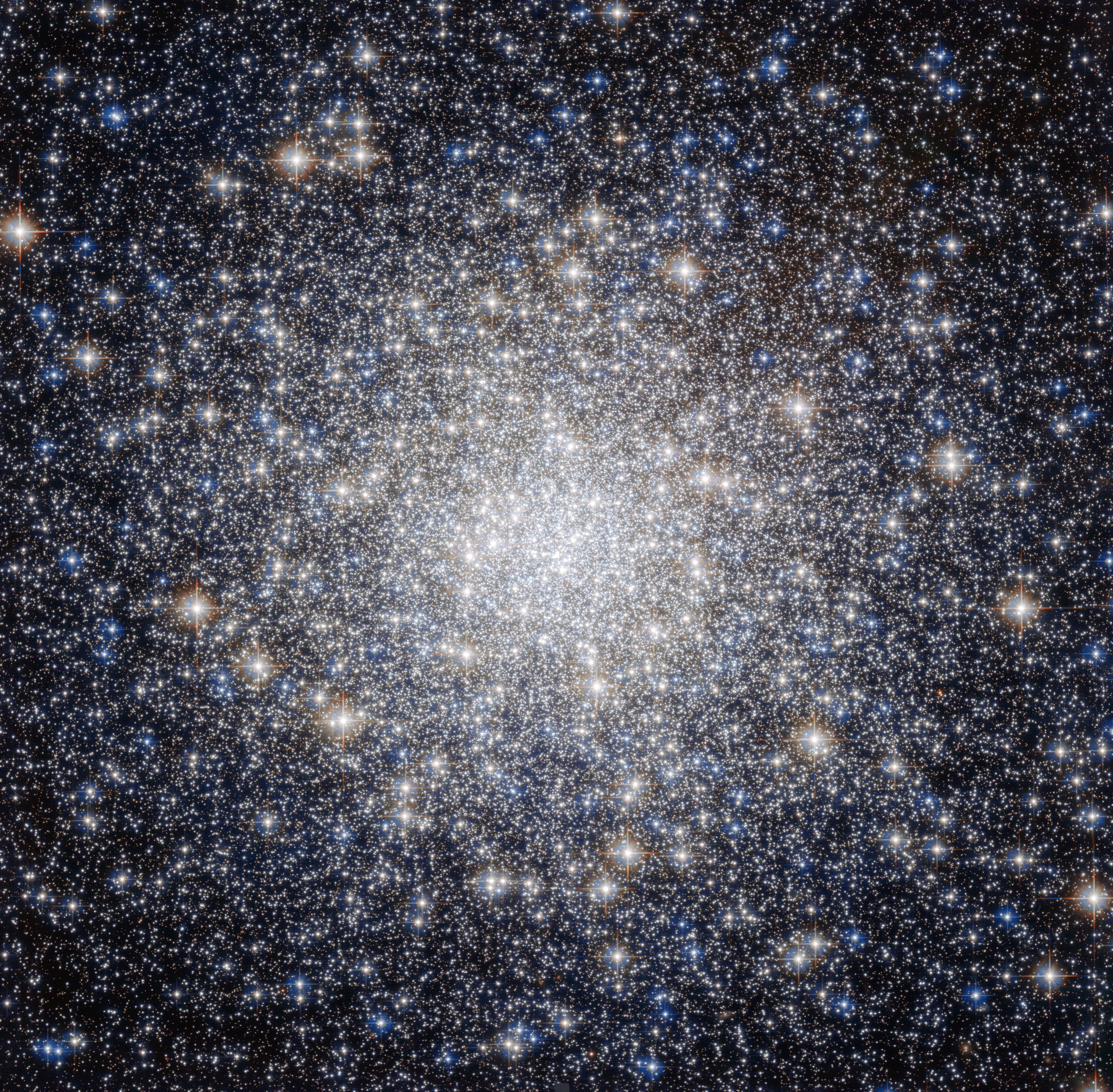 This striking new NASA/ESA Hubble Space Telescope image shows a glittering bauble named Messier 92. Located in the northern constellation of Hercules, this globular cluster — a ball of stars that orbits a galactic core like a satellite — was first discovered by astronomer Johann Elert Bode in 1777. Messier 92 is one of the brightest globular clusters in the Milky Way, and is visible to the naked eye under good observing conditions. It is very tightly packed with stars, containing some 330 000 stars in total. As is characteristic of globular clusters, the predominant elements within Messier 92 are hydrogen and helium, with only traces of others. It is actually what is known as an Oosterhoff type II (OoII) globular cluster, meaning that it belongs to a group of metal-poor clusters — to astronomers, metals are all elements heavier than hydrogen and helium. By exploring the composition of globulars like Messier 92, astronomers can figure out how old these clusters are. As well as being bright, Messier 92 is also old, being one of the oldest star clusters in the Milky Way, with an age almost the same as the age of the Universe. A version of this image was entered into the Hubble’s Hidden Treasures image processing competition by contestant Gilles Chapdelaine. Links Gilles Chapdelaine’s Hidden Treasures entry on Flickr
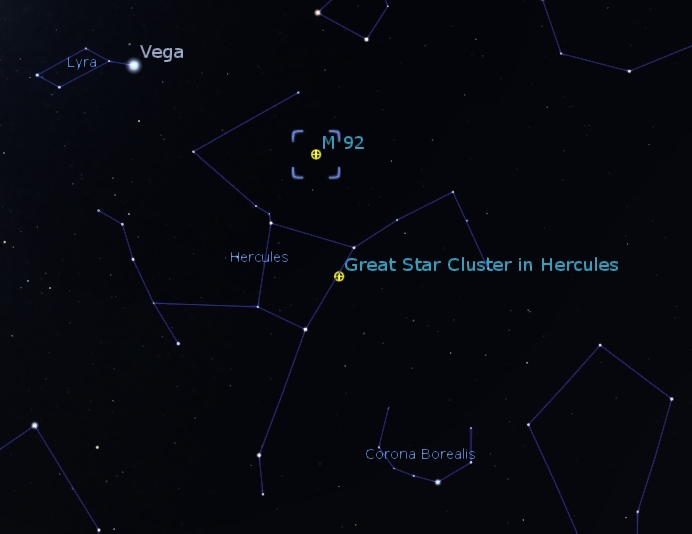 Location of M92 in the constellation Hercules. Credit: Stellarium / Bob Trembley.
The Sun
The Sun has been spot-free for 7 days. The huge northern coronal hole remains from last week; a couple smaller holes appear along the equator. There is no sign of a coronal hole at the south pole. Some coronal loop activity appears between the equatorial holes. The solar wind speed is 487.6 km/sec, with a density of 5.5 protons/cm3.
SpaceWeather.com says: “A fast-moving stream of solar wind is approaching Earth. Estimated time of arrival: Sept. 7th. The gaseous material is flowing from a large hole in the sun’s atmosphere. Arctic sky watchers should be alert for auroras later this week.”
Several rather nice prominences appear all over the Sun in the last couple days. The region of coronal loop activity shown above appears as the bright orange region on the equator in the animation below.
You can create your own time-lapse movies of the Sun here: AIA/HMI Browse Data.
You can browse all the SDO images of the Sun from 2010 to the present here: Browse SDO archive.
Asteroids
Upcoming Earth-asteroid encounters:
| Asteroid |
Date(UT)
|
Miss Distance
|
Velocity (km/s)
|
Diameter (m)
|
| 2018 DE1 |
2018-Aug-30
|
15.2 LD
|
6.5
|
28
|
| 2018 QW1 |
2018-Aug-30
|
9.1 LD
|
13.8
|
117
|
| 2018 RA |
2018-Sep-01
|
3 LD
|
6.9
|
16
|
| 2001 RQ17 |
2018-Sep-02
|
19.3 LD
|
8.3
|
107
|
| 2015 FP118 |
2018-Sep-03
|
12.3 LD
|
9.8
|
490
|
| 2018 QA |
2018-Sep-03
|
17.5 LD
|
20.4
|
73
|
| 2018 QU1 |
2018-Sep-11
|
10.9 LD
|
12.5
|
99
|
| 2017 SL16 |
2018-Sep-20
|
8.5 LD
|
6.4
|
25
|
| 2018 EB |
2018-Oct-07
|
15.5 LD
|
15.1
|
155
|
| 2014 US7 |
2018-Oct-17
|
3.2 LD
|
8.7
|
19
|
| 2013 UG1 |
2018-Oct-18
|
10.4 LD
|
13.4
|
123
|
| 2016 GC221 |
2018-Oct-18
|
8.7 LD
|
14.4
|
39
|
| 475534 |
2018-Oct-29
|
7.5 LD
|
18.1
|
204
|
Notes: LD means “Lunar Distance.” 1 LD = 384,401 km, the distance between Earth and the Moon. Table from SpaceWeather.com
Near-Earth objects (NEOs) discovered this month: 3, this year: 1115, all time: 18667.
Potentially hazardous asteroids: 1923 (as of September 5, 2018)
Minor Planets discovered: 779,736 (as of July 31, 2018)
Fireballs
On Sept. 5, 2018, the NASA All Sky Fireball Network reported 28 fireballs.
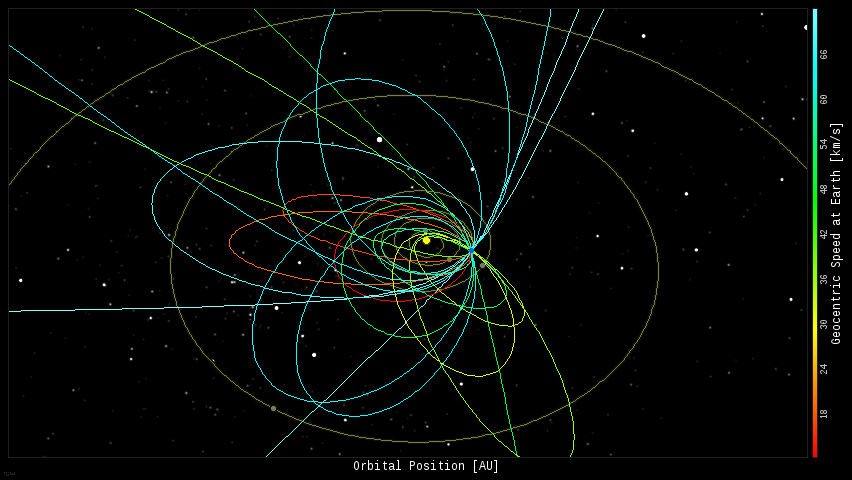 In this diagram of the inner solar system, all of the fireball orbits intersect at a single point–Earth. Source: Spaceweather.com
The Solar System
This is the position of the planets and a couple spacecraft in the solar system:
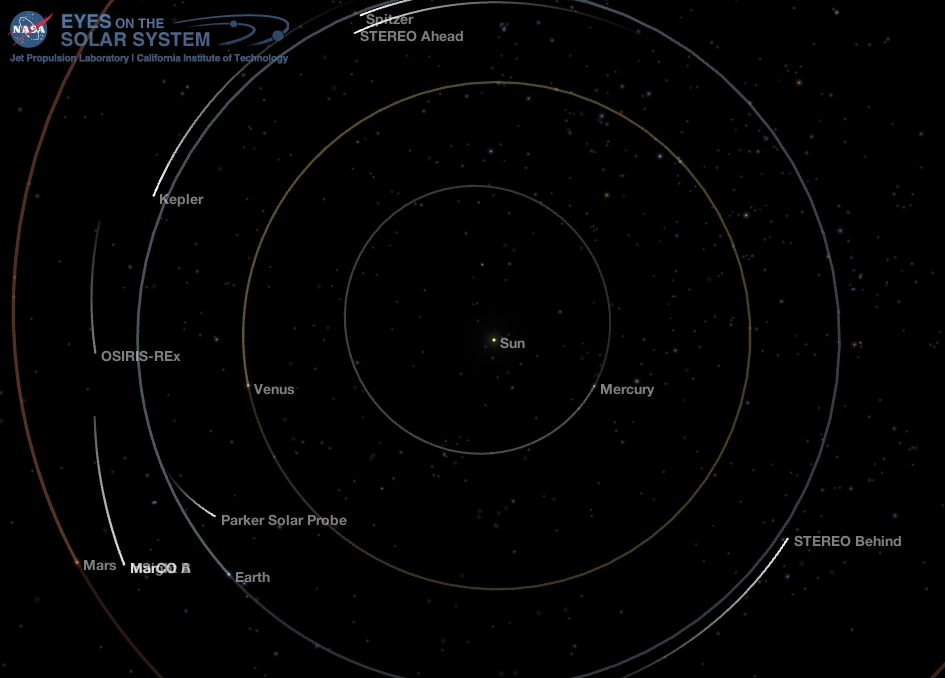 Position of the planets and a few spacecraft in the inner system, Sept. 5 2018. Credit: NASA Eyes on the Solar System / Bob Trembley.
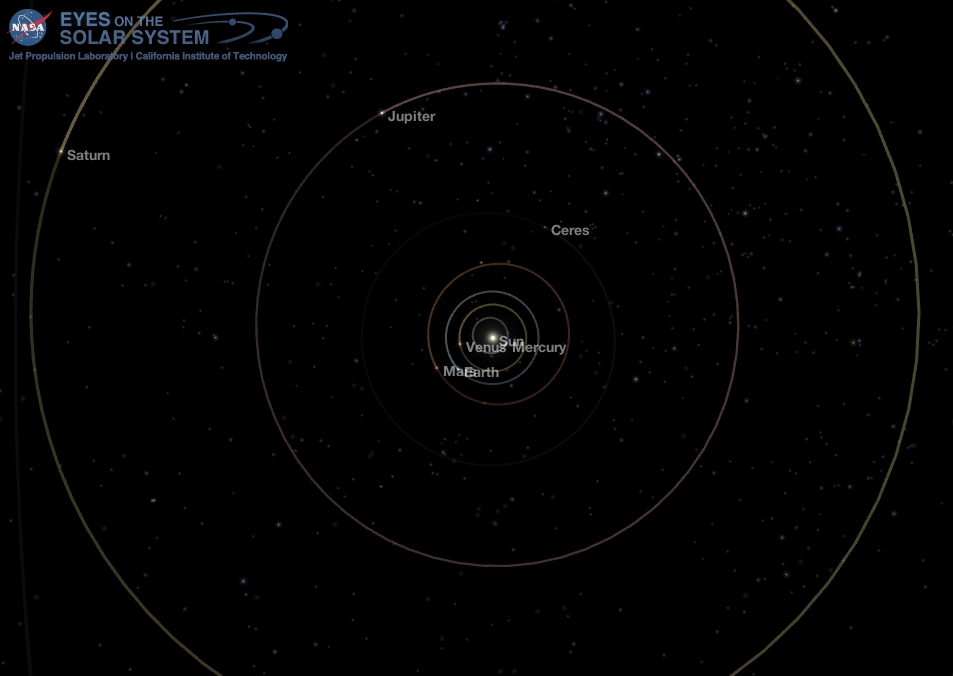 Position of the planets in the middle system, Sept. 5, 2018. Credit: NASA Eyes on the Solar System / Bob Trembley.
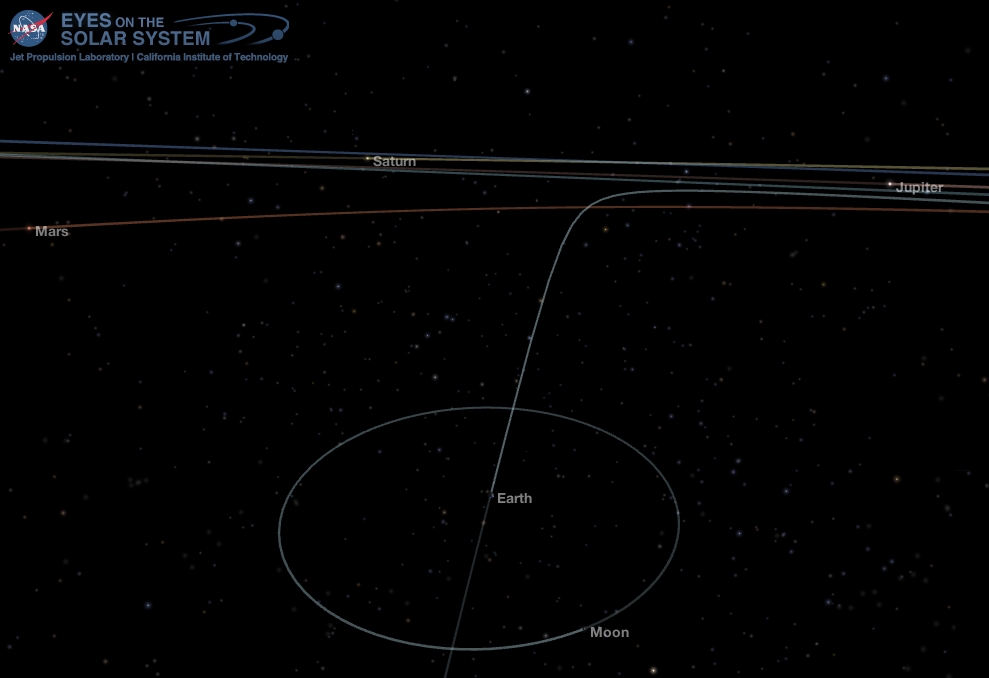 Above and ahead of the Earth, looking back along Earth’s orbit, Sept. 5, 28 2018. Credit: NASA Eyes on the Solar System / Bob Trembley.
Spacecraft
The OSIRIS-REx asteroid sample return spacecraft is less than one million miles from its target.
NASA’s Voyager 1 spacecraft was launched 41 years ago today!
Exoplanets
Confirmed Exoplanets: 3,778 (8/23/2018)
Multi-Planet Systems: 625 (8/23/2018)
Kepler Candidate Exoplanets: 4,496 (8/31/2017)
TESS Candidate Exoplanets: 0
Data from the NASA Exoplanet Archive
Apps used for this post:
NASA Eyes on the Solar System: an immersive 3D solar system and space mission simulator – free for the PC /MAC.
I maintain the unofficial NASA Eyes Facebook page.
Stellarium: a free open source planetarium app for PC/MAC/Linux. It’s a great tool for planning observing sessions.
Aside: When I gather screen-shots from Stellarium, I typically pause time within the app. This morning, I was scrolling around and landed on the constellation Hercules. Looking at Hercules, I said “That’s not RIGHT!” There was an extra star there! I clicked on it, and it was NORAD satellite “USA 186.” I happened to pause the app when the satellite was in Hercules. The fact that I recognized that Hercules didn’t look right kinda shocked me!
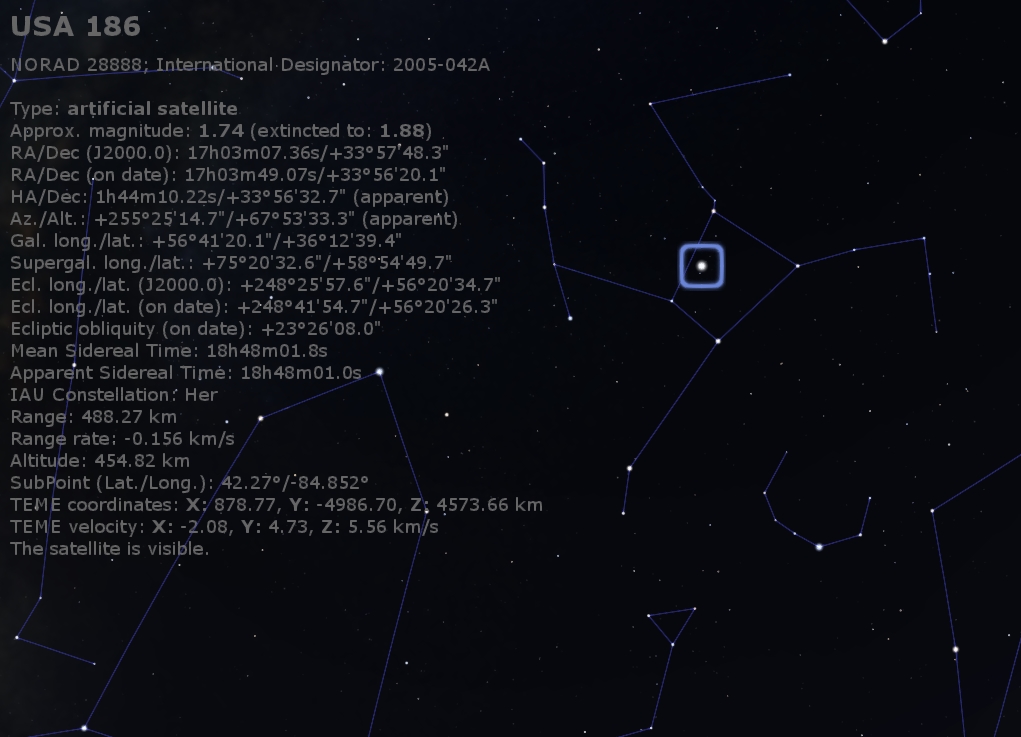 NORAD satellite USA 186 in the constellation Hercules. Credit: Stellarium / Bob Trembley.
 2018 is NASA’s 60th anniversary!