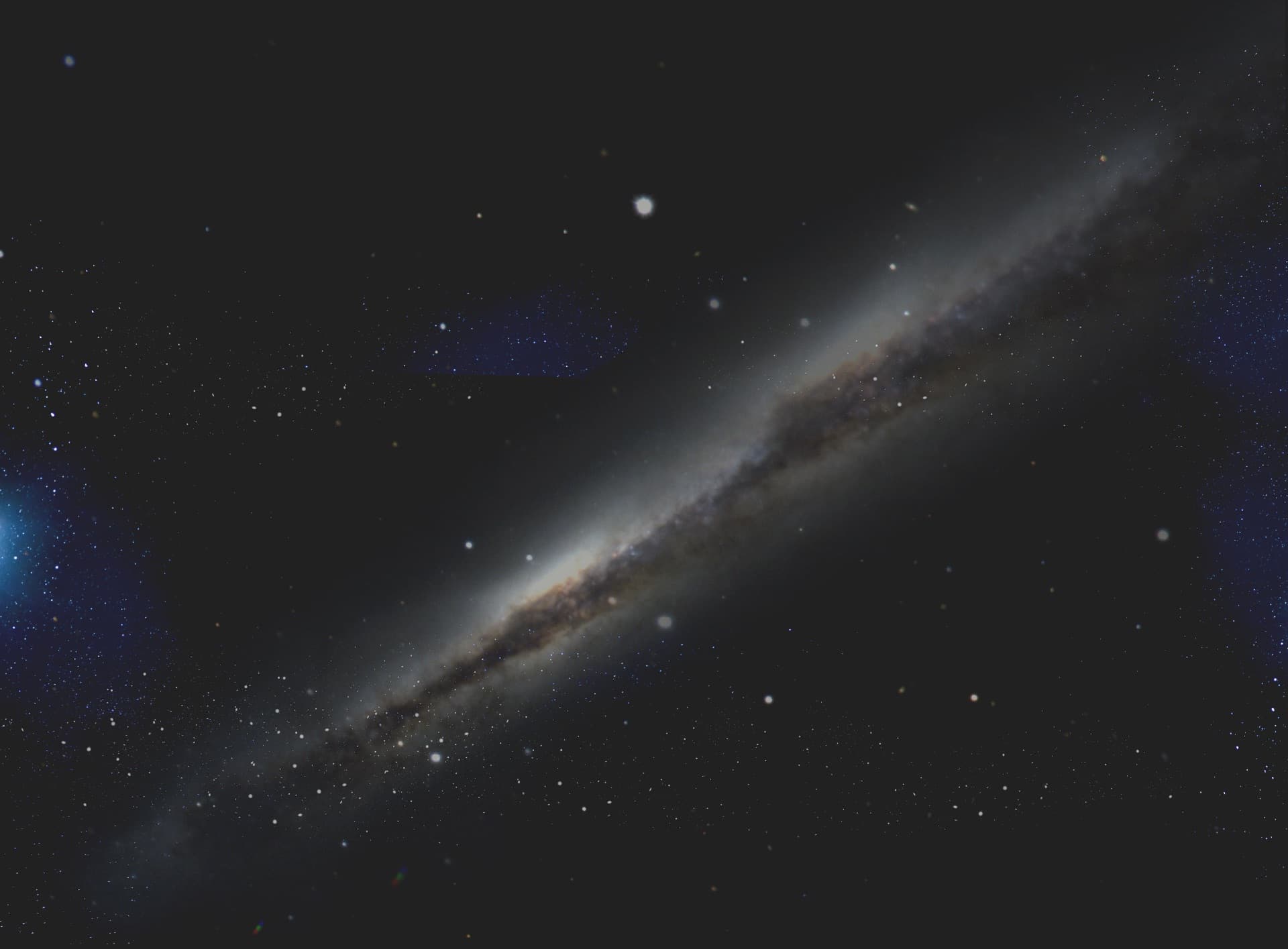
Using data from the NASA Kepler space telescope, scientists have confirmed the first near-Earth-size planet orbiting in the habitable zone of a sun-like star, 1400 light-years away.
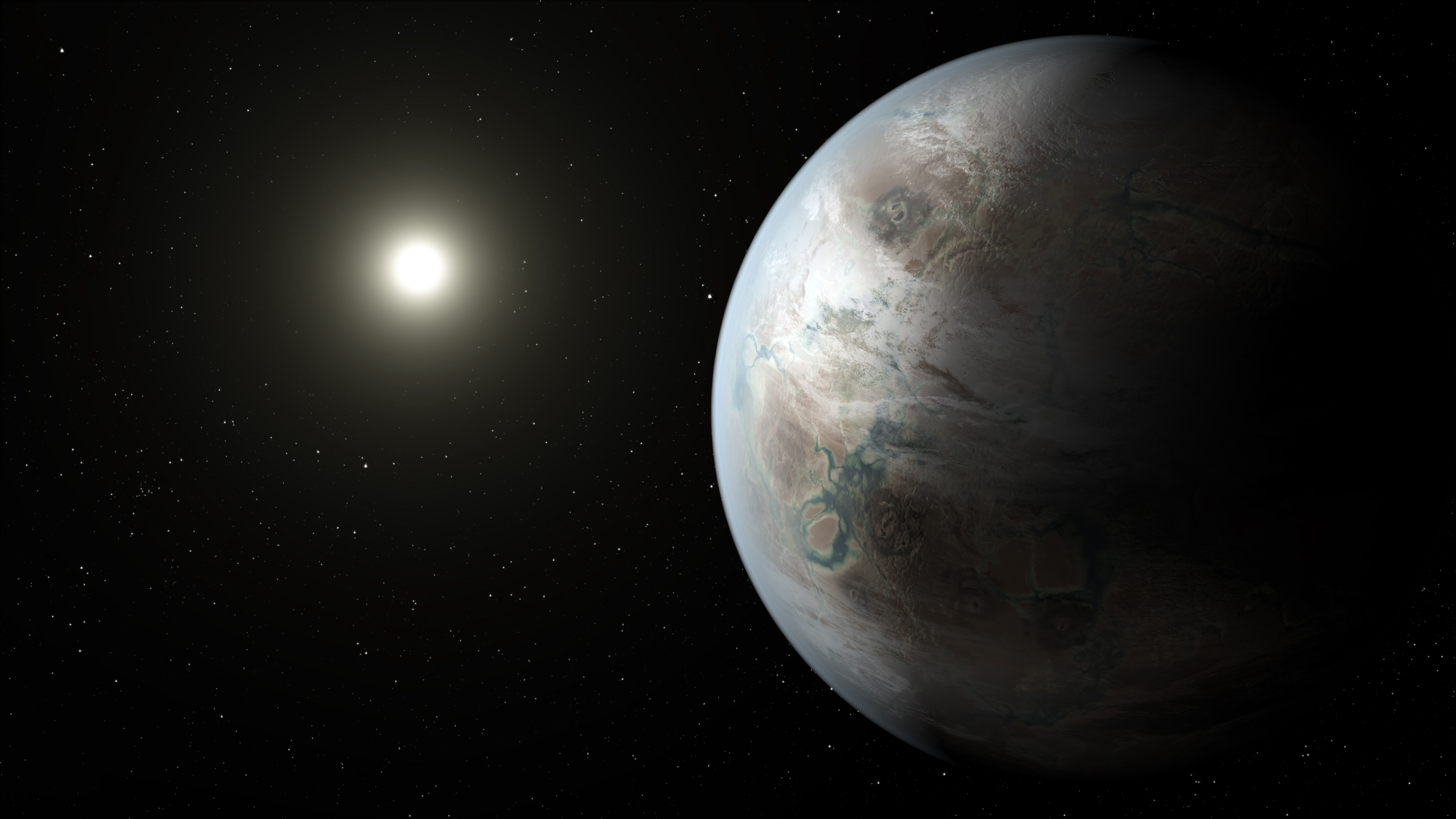 This artist’s concept depicts one possible appearance of the exoplanet Kepler-452b, the first near-Earth-size world to be found in the habitable zone of star that is similar to our sun. Image credit: NASA Ames/JPL-Caltech/T. Pyle
A star’s habitable zone is an orbital region where temperatures are just right for water to exist on planetary surfaces. Earth-sized exoplanets (or exomoons) within the habitable zone (sometimes referred to as the “Goldilocks zone”), with liquid water on their surfaces, are good candidates for hosting life.
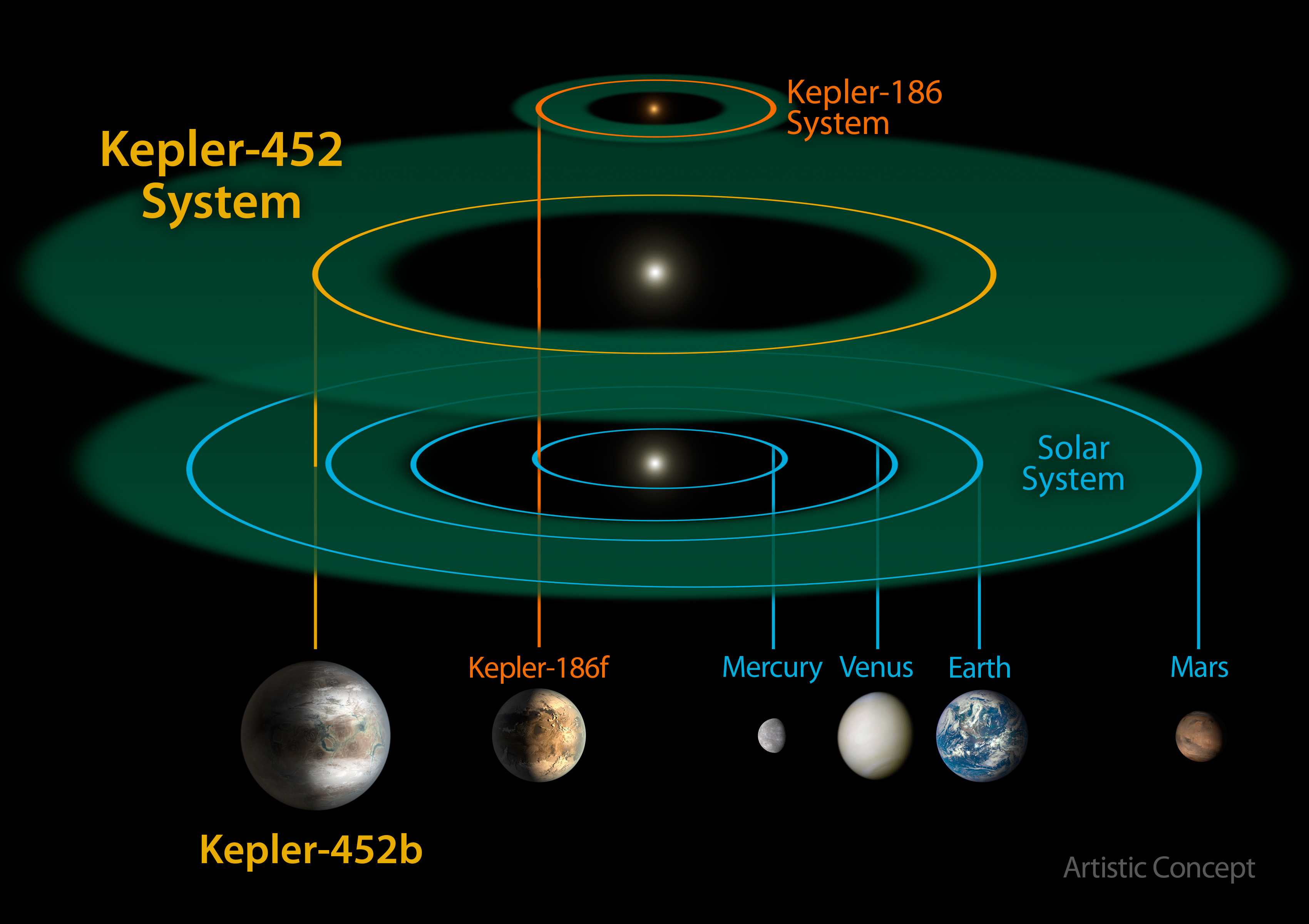 This size and scale of the Kepler-452 system compared alongside the Kepler-186 system and the solar system. Credit: NASA Ames/JPL-CalTech/R. Hurt
Kepler-452b is about 60% larger than Earth, and more massive – this type of exoplanet is typically referred to as a “Super-Earth;” a human standing on its surface would weigh almost twice as much as they would on Earth.
Both Earth and Kepler-452b orbit a G2-type star, each about the same temperature. Kepler-452b’s star is 1.5 billion years older than our sun (about 6 billion years old), and is hotter and brighter than our Sun.
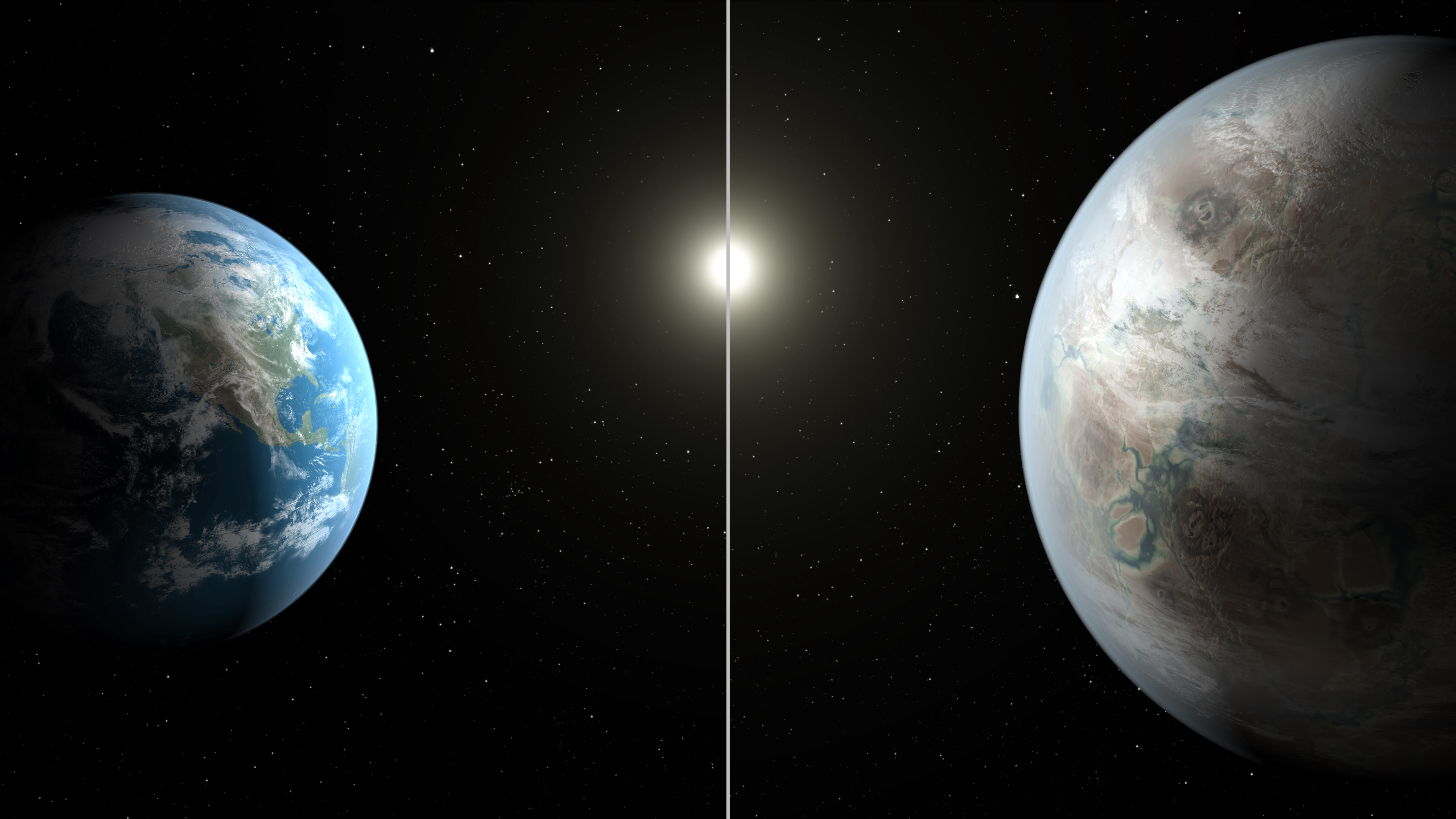 Artist’s concept comparing Earth (left) to the new exoplanet, called Kepler-452b, which is about 60% larger. The illustration represents one possible appearance for Kepler-452b — scientists do not know whether the planet has oceans and continents like Earth. Image credit: NASA/Ames/JPL-Caltech/T. Pyle
Kepler-452b is receiving ten percent more energy from its parent star than Earth is currently receiving from the Sun; if Kepler-452b is a rocky world, it may not possess a habitable environment – it could be suffering from a runaway greenhouse effect similar to Venus.
Some media agencies are headlining that “Earth 2.0” has been found; I have to give that kind of sensationalism the squinty-eye of disdain – it’s a bit too early to be making claims like that. This extensive NASA briefing refers to Kepler-452b as “Earth’s Bigger, Older Cousin” – I like that much better.
The briefing also states: “The first exoplanet orbiting another star like our sun was discovered in 1995. Exoplanets, especially small Earth-size worlds, belonged within the realm of science fiction just 21 years ago.” I was struck by two thoughts: Carl Sagan would have just LOVED this, and how frequently in recent years some aspect of science fiction has become reality.
The Kepler space telescope has scanned only a tiny portion of the northern sky – in the constellations of Cygnus, Lyra and Draco; it has discovered hundreds of exoplanets, with thousands more candidates awaiting confirmation. A study from the PLANET (Probing Lensing Anomalies NETwork) collaboration estimates there are more than 10 billion terrestrial planets across our galaxy.
 Kepler mission search volume. Credit: Jon Lomberg/NASA
 Kepler ’s investigated area. Credit: Software Bisque/NASA/Ames/JPL-Caltech
| Confirmed Planets (mission and community) |
1033 |
| Candidates and Confirmed in Habitable Zone (180 K < Equilibrium (T) < 310 K) or (0.25 < Insolation (Earth flux) < 2.2) |
300 |
| Kepler Project Candidates | 4696 |
| Kepler Project Unconfirmed Candidates | 3704 |
| Total Candidates and Confirmed Planets | 4737 |
See also:
http://www.nasa.gov/multimedia/imagegallery/image_feature_2233.html
http://www.space.com/30034-earth-cousin-exoplanet-kepler-452b-life.html
http://www.nytimes.com/2015/07/24/science/space/kepler-data-reveals-what-might-be-best-goldilocks-planet-yet.html?_r=0
https://en.wikipedia.org/wiki/Kepler-452b
Exoplanet Archive: http://exoplanetarchive.ipac.caltech.edu/
 Artist’s rendition of Kepler spacecraft. Credit: NASA/Kepler mission/Wendy Stenzel