Today is the day of the December solstice! This is the day on which the sun reaches its southernmost point in its yearly journey through the stars (as seen from Earth). Thus, in the northern hemisphere, the maximum daily altitude that sun reaches (when it is at the point halfway between rising and setting) is the lowest of the whole year. The length of the sun’s day-long arc above the horizon is therefore shortest. Consequently, the length of time that the sun is above the horizon is shortest, and the duration of daylight is shortest. A sun that is low in the sky and not up for very long will not warm things much. Thus in the northern hemisphere the December solstice is the “winter” solstice.
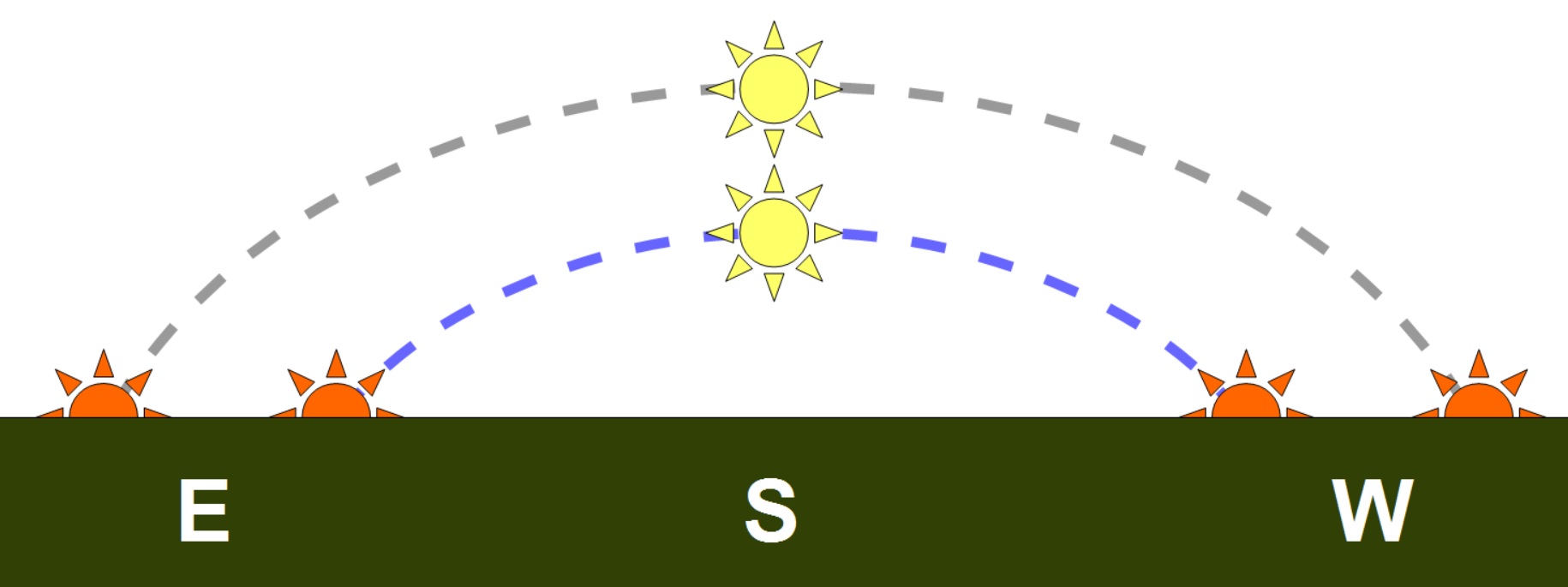 The sun rises in the east and sets in the west. The time between one rising and the next is 24 hours, and the sun’s motion across the sky is always at the same rate. Thus when the sun is lower in the sky (blue dashed line) its path is shorter, and it is above the horizon for less time, than when it is higher in the sky (gray dashed line).
Of course the situation in the southern hemisphere is just the opposite: the sun’s maximum daily altitude, the length of the sun’s arc above the horizon, and the duration of daylight are all greatest. A sun that is high in the sky and up for a long time warms things quite well. Thus in the southern hemisphere this is the “summer” solstice.
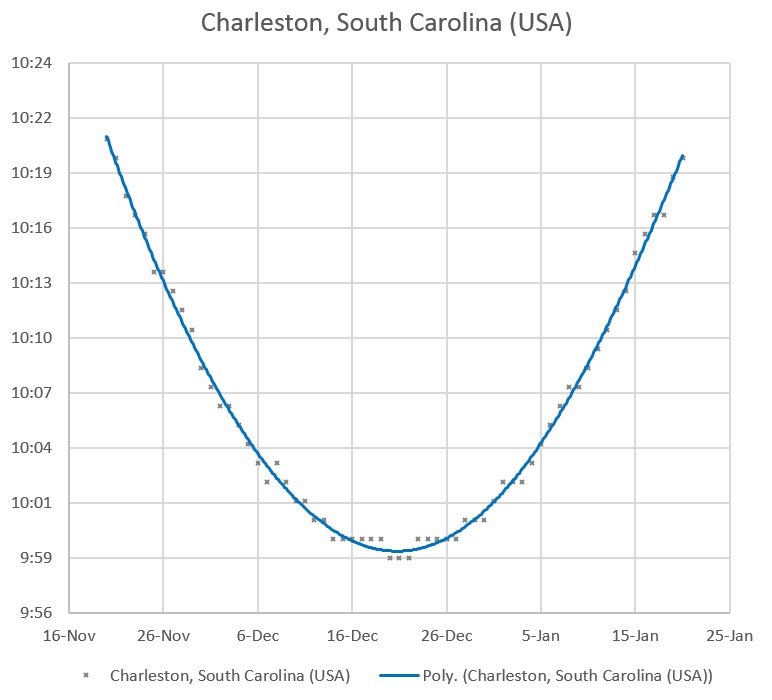 Plot showing the amount of time the sun is above the horizon (in hours:minutes, on the vertical axis) vs. date for Charleston, South Carolina, USA. This reaches a minimum at the December 21 solstice. Note that a plot like this will differ for different northern hemisphere cities depending on their latitudes (locations farther from the equator having less sun time), but the general plot characteristics will be the same.*
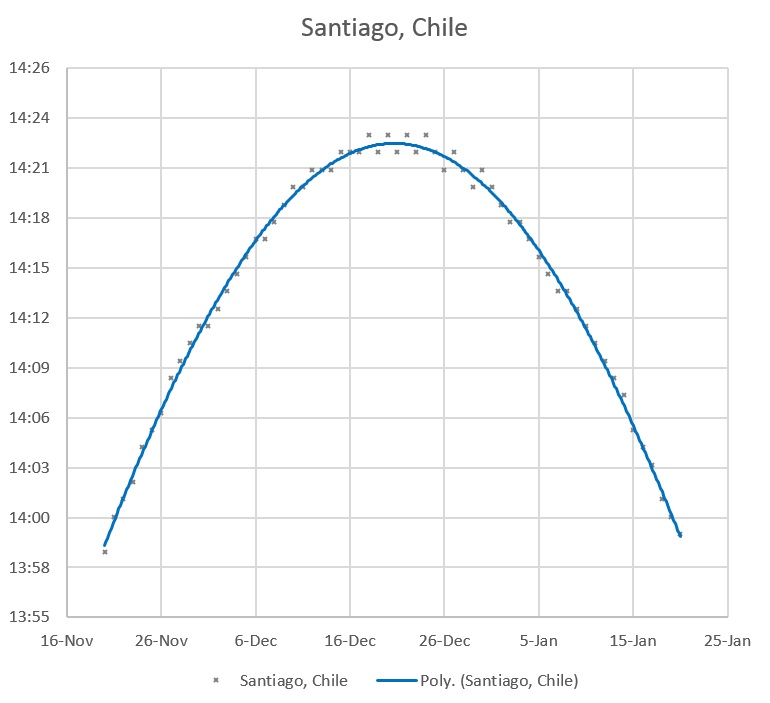 Plot showing the amount of time the sun is above the horizon (in hours:minutes, on the vertical axis) vs. date for Santiago, Chile. This reaches a maximum at the December 21 solstice. Note that a plot like this will differ for different southern hemisphere cities depending on their latitudes (locations farther from the equator having more sun time), but the general plot characteristics will be the same.*
Of course, as mentioned in the previous post on the solstice, just because today is the shortest/longest day does not mean the times of sunrise and sunset are behaving as expected. More on that to come in a future post!
*Plots are based on data from the US Naval Observatory.