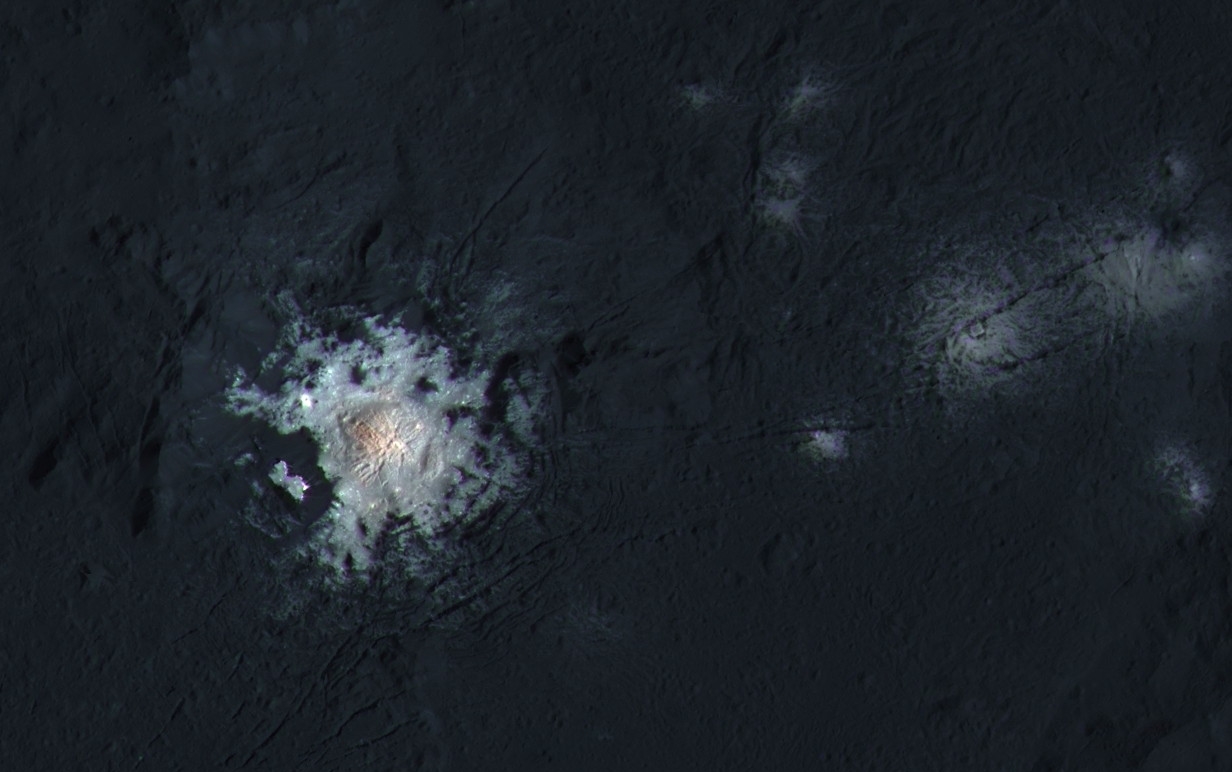
 Bright central spots near the center of Occator Crater on Ceres, shown in enhanced color. Credit: NASA/JPL-Caltech/UCLA/MPS/DLR/IDA/PSI/LPI
The Dawn mission team has produced this high-resolution enhanced-color image of the bright spots in Occator crater on Ceres. In the crater’s center, the close-up reveals a fractured dome surrounded by a smooth-walled pit.
The image above was created by combining high-resolution images of Occator crater obtained in February 2016, with color images obtained in September 2015. Color images were taken using 438, 550 and 965 nanometer filters (the latter in the near-infrared, and slightly beyond the range of human vision).
Compare that with the image below, taken during Dawn’s approach to Ceres in early 2015; at that time, the spots were all over the news as “The Mysterious Bright Spots.”
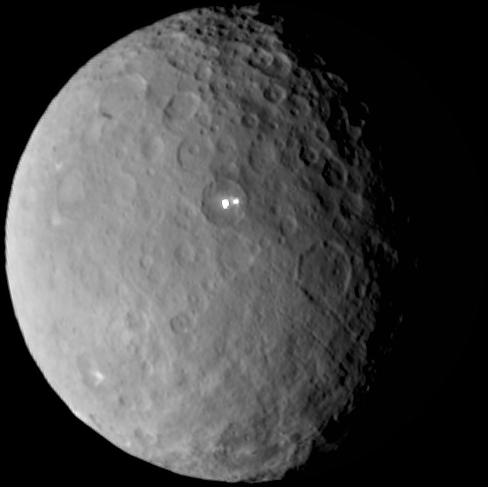 Ceres from Dawn on 19 Feb. 2015 from 46,000 km (29,000 mi). This image was taken before the Dawn entered into orbit of Ceres. Credit: NASA/JPL-Caltech/UCLA/MPS/DLR/IDA
The bright spots on Ceres are best explained as the result of briny water erupting from Ceres’ interior, and then sublimating away into space, leaving behind salty deposits and ammonia-rich clays.
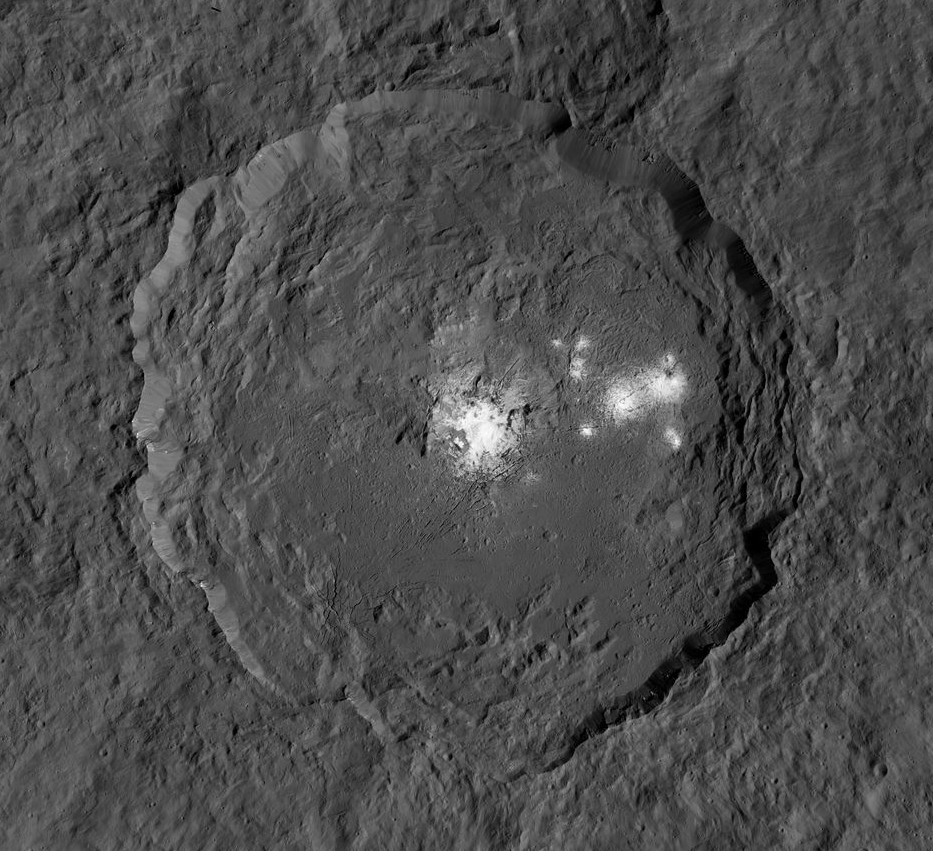 Occator crater measures 92 km (57 mi) across, and is 4 km (2.5 mi) deep. Credit: NASA/JPL-Caltech/UCLA/MPS/DLR/IDA/PSI